
The current entry requirements for tourists to Canada trip up more travelers than any other part of the planning process, and that’s not an exaggeration. Book your flights first, figure out the visa later, that approach has cost thousands of people their deposits, their vacations, and in some cases, their spot at the Canadian border. Don’t let it happen to you.
Whether you’re heading to Toronto for Niagara Falls, flying into Vancouver for the mountains, or one of the millions who’ll descend on Canada for the FIFA World Cup 2026, the rules around who gets in, what documents they need, and how long they can stay carry specific nuances that shift depending entirely on your passport. Your nationality dictates your path. Some travelers tap through a five-minute online form and they’re done. Others spend months assembling a full visa application and still face uncertainty. This guide tells you clearly which category you fall into, and exactly what to do next.
eTA vs Visitor Visa: Which One Do You Actually Need?
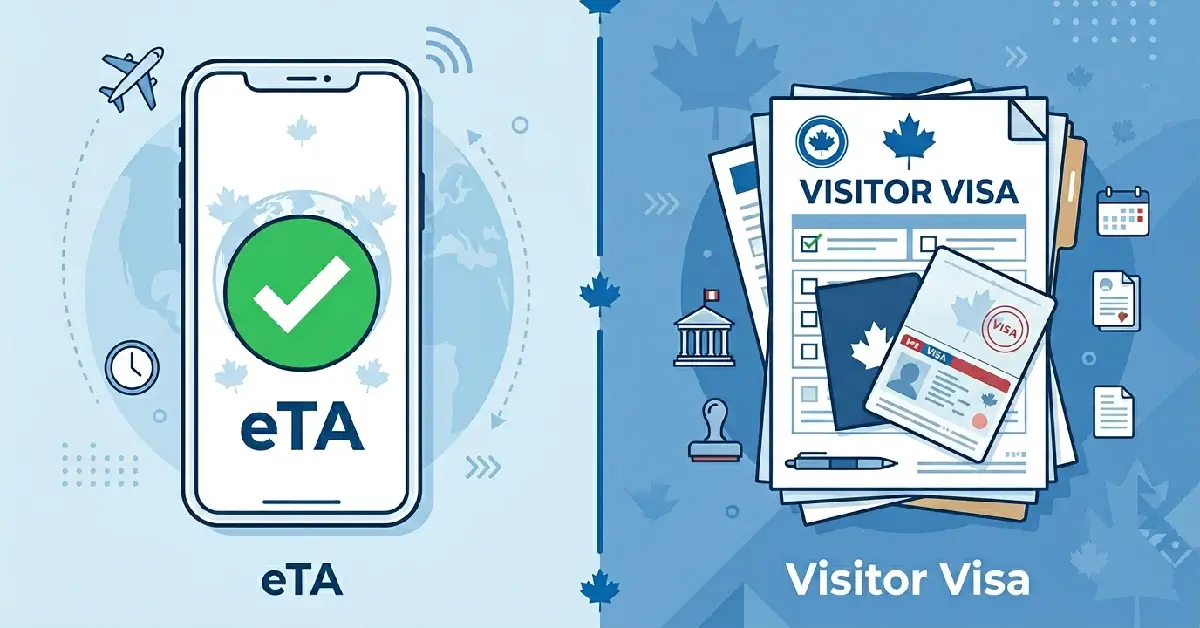
This is the first question to answer, and your passport holds the answer.
Canada splits all international tourists into two distinct groups: those who need an Electronic Travel Authorization (eTA), and those who need a full Temporary Resident Visa (TRV). Getting this wrong wastes time, money, and sometimes results in being turned away at the gate.
Go to canada.ca/eta. That is the only official government site.”
Ee sentence ni ila rewrite cheyandi: “First, check if you need a visa or eTA using the official IRCC eligibility tool, then go to canada.ca/eta to apply.
The eTA: Fast, Cheap, and Easy, If It Applies to You
Citizens of visa-exempt countries, the UK, most EU nations, Australia, Japan, South Korea, and several others, skip the full visa process entirely. When flying to Canada, they need only an eTA, a lightweight electronic permission that links directly to the passport and takes most people under 10 minutes to obtain.
Here’s the eTA vs visitor visa Canada entry rules breakdown in plain terms: the eTA is not a visa. It carries no sticker, no stamp, no in-person appointment. It’s a digital flag tied to your passport number, telling airlines and border officers that Canada has pre-cleared you to board.
What the eTA costs and how it works:
- Cost: CAD $7,apply only at canada.ca/eta; third-party sites charge far more for the exact same result
- Processing: Most approvals land in your inbox within minutes; occasionally a few days if IRCC needs more information
- Validity: 5 years or until your passport expires, whichever comes first
- Coverage: Air travel only, crossing by land or sea from the US does not require an eTA
One notable 2026 update: as of May 26, 2026, certain citizens of Indonesia and Malaysia now qualify for an eTA rather than a full visitor visa, a meaningful change for travelers from those countries who previously faced the longer TRV process.
How to apply for Canada eTA online for tourists, step by step:
- Visit canada.ca/eta (the official government site, ignore every other one)
- Grab your passport, a credit or debit card, and your email address
- Work through the short online questionnaire
- Pay CAD $7
- Check your email, the approval arrives electronically and attaches to your passport automatically
The Visitor Visa (TRV): For Everyone Else
Citizens of visa-required countries, India, China, Nigeria, the Philippines, Pakistan, and the vast majority of African, South Asian, and Southeast Asian nations, cannot use the eTA route. They must apply for a Temporary Resident Visa (TRV) through Immigration, Refugees and Citizenship Canada (IRCC). This is a full application — forms, documents, biometrics, the lot.
Here’s why planning ahead matters more than most people realize. The Canada visitor visa processing time 2026 varies wildly depending on where you apply from:
| Country of Application | Approximate Processing Time (2026) |
|---|---|
| India | 27–88 days (varies by visa office) |
| Nigeria | 85+ days |
| Philippines | 4–8 weeks |
| Pakistan | 8–12 weeks |
| Mexico | 4–6 weeks |
| United States | ~14 days |
IRCC released fresh processing data in April 2026 showing Indian applicants now wait roughly 27 calendar days, up from 23 earlier in the year, largely because Delhi and Chandigarh processed over 193,000 TRV applications in Q1 2026 alone, a 27% jump year-on-year. Nigerian applicants routinely wait beyond 85 days. The bottom line: apply at least 3 months before your travel date, not as a rough target, but as a hard minimum if you want a real buffer against delays.
Must Read: 7 Expert Tips for Navigating Bali Like a Local
US Citizens vs Everyone Else: One of the Most Misunderstood Rules
Few topics generate more confusion than Canada entry requirements for US citizens vs others, and the distinction is significant.
American citizens enjoy the simplest path of all:
- No visa, no eTA, a valid US passport gets you through any entry point
- At land borders, some officers accept an Enhanced Driver’s License or NEXUS card, but carry a full passport to avoid any friction
- Stays run up to 6 months by default; border officers can extend this to a full year if your documentation justifies it
- Canada permanently lifted all COVID-19 vaccination and testing requirements, none of that applies in 2026
US Green Card holders (Permanent Residents):
- Canada exempted them from the eTA requirement back in April 2022
- They must carry both their valid foreign passport and their Green Card, one without the other creates problems at the border
Citizens of all other countries: Follow the eTA or TRV path based on their passport nationality. No shortcuts, no exceptions.
Documents Required for Canada Tourist Visa Application
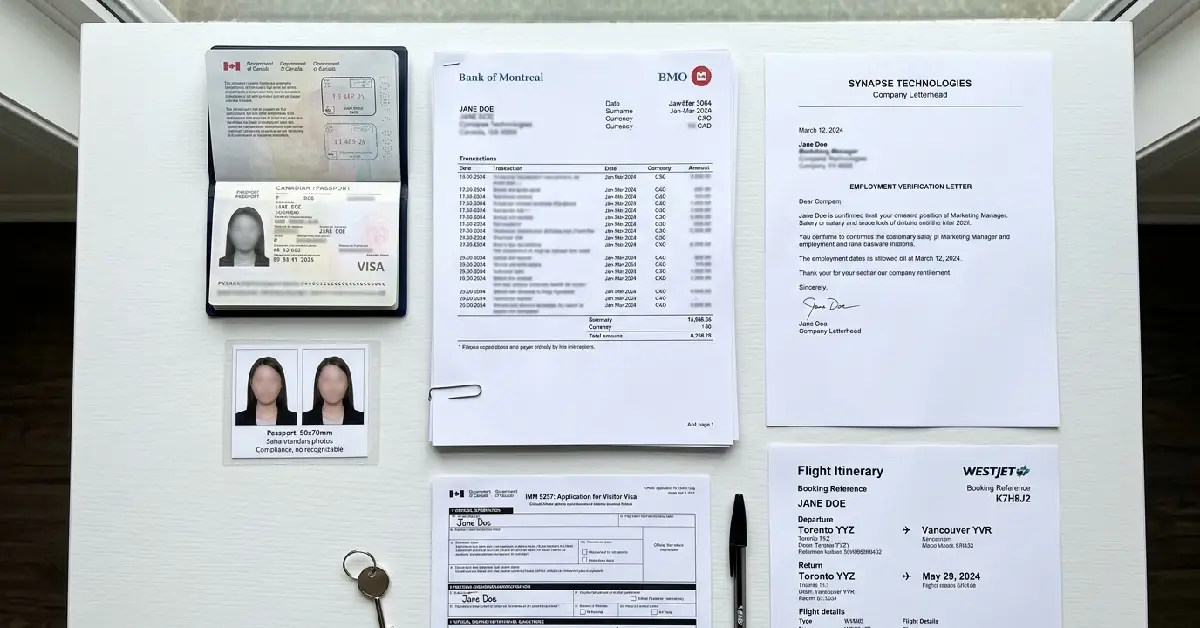
A TRV application lives or dies on the quality of the file you submit. Officers don’t just check whether documents exist, they evaluate whether the story those documents tell is consistent, credible, and compelling.
Mandatory documents, you cannot submit without these:
- Valid passport (covers your full intended stay, with at least one blank page for stamps)
- Completed IMM 5257 form (the Temporary Resident Visa application)
- Two recent passport-sized photos meeting IRCC’s specifications
- Bank statements covering the last 3–6 months (proof of financial means)
- Employment letter, pay slips, or student ID (proof of occupation and status)
- Travel itinerary, confirmed flight bookings, hotel reservations, planned activities
- Travel insurance documentation (not legally mandatory, but meaningfully strengthens your file)
- Purpose of visit letter written by you, explaining your plans clearly and specifically
Supporting documents that genuinely move the needle:
- Property ownership records, title deeds, mortgage statements
- Family dependency proo, children, spouse, or parents who remain at home
- Previous passports carrying international visa stamps (positive travel history)
- A detailed invitation letter from your Canadian host, if you’re visiting family or friends
Passport Validity Requirements to Enter Canada
Canada demands your passport stay valid for your entire stay, not just the day you land. A passport that expires mid-trip isn’t a minor administrative inconvenience; border officers will flag it and potentially turn you back. Beyond expiry, check that you have at least one completely blank page for entry stamps before you travel.
Biometrics: What You Need to Know Before You Apply
Canada requires most TRV applicants to give biometrics, fingerprints and a digital photo, at a licensed Visa Application Centre (VAC). This happens separately from your online application submission. The fee runs CAD $85 per person, or CAD $170 for a family applying together.
The important nuance: biometrics remain valid for 10 years for most applicants. Check your IRCC account first , if you’ve given biometrics within the last decade, you may not need another appointment, which shaves days or weeks off your overall timeline.
Proof of Funds and Home Ties: Where Most Applications Succeed or Fail
Strip away all the paperwork, and two factors drive the majority of visitor visa decisions: money and roots. Officers want to know that you can pay for your trip, and that you have compelling reasons to leave Canada when your authorized time ends.
Proof of Funds for Canada Tourist Visa
Canada publishes no official minimum balance requirement, but immigration consultants consistently work with a practical benchmark of CAD $2,500–$4,000 per month of intended stay, supported by genuine, consistent bank records.
The mistake applicants keep making: depositing a large lump sum right before applying. Officers see this constantly. It’s an instant credibility red flag. A steady financial history, regular income, normal spending patterns, a reasonable balance, tells a far more convincing story than a sudden injection of funds the week before submission.
Ties to Your Home Country
This is the second pillar, and it matters just as much. Officers need confidence that you’ll respect your authorized stay and leave when required. The stronger your ties to your home country, the easier that case is to make. Strong ties include:
- Full-time employment with an employer letter confirming your leave of absence and expected return date
- Property ownership, title deeds or active mortgage documentation
- Dependent family members who stay home during your trip (spouse, young children, elderly parents)
- An active business registered in your home country
- Ongoing study or enrollment at a home institution
Think of it this way: the officer is asking, “Does this person have a life worth coming back to?” Your documents need to answer that question loudly and clearly.
Canada Entry Requirements for Tourists from India

Given the scale of Indian applications, this topic warrants its own section. Canada entry requirements for tourists from India follow the standard TRV process, no eTA eligibility, regardless of travel history or income level, but the volume of applications from India creates additional practical complications that applicants need to understand.
India now ranks as Canada’s top source market for immigration applications overall. IRCC data from April 2026 shows the Delhi and Chandigarh visa offices together processed over 193,000 visitor visa applications in Q1 2026 alone. That surge is what pushed processing times from 23 to 27 days, and if application volumes continue climbing, timelines will likely stretch further through peak summer months.
What Indian applicants need to prioritize:
- Book your VAC biometrics appointment as early as possible, slots in Delhi, Mumbai, and Chennai fill weeks out during high season
- Submit 3–6 months of clean, consistent bank statements; avoid large unexplained deposits in the run-up to your application
- Anchor your file with strong home ties, employment confirmation, property records, family dependency documents
- Submit your application no later than 3 months before your intended departure, and lean toward 4 months if you’re traveling between May and August
For travelers from Nigeria and the Philippines, a visitor visa is equally mandatory. Nigerian applicants face tighter scrutiny than most, approval rates sit in the 40–50% range, and wait times regularly exceed 85 days. Filipino applicants fare better, with 4–8 week timelines and stronger approval rates, provided employment documentation is solid.
How Long Can Tourists Stay in Canada?
The standard answer is 6 months, and for most visitors, that’s accurate. But there’s a detail most travelers don’t know: since early 2026, border officers hold broader discretion to authorize stays of up to 1 year for visitor visa holders who arrive with thorough documentation, a clear itinerary, solid proof of funds, and a credible departure plan.
What this means in practice:
- The date the border officer records at entry is your legal deadline, not the date on your visa
- You can apply to extend your authorized stay from inside Canada, but you must do so before that date passes
- Working or studying in Canada without the correct permit is a serious immigration violation, regardless of how long the officer authorized your stay
How long can tourists stay in Canada without a visa (for US citizens and other visa-exempt nationals)? The same 6-month default applies, with the same officer discretion at the border.
ArriveCAN and Customs Declaration: What’s Changed
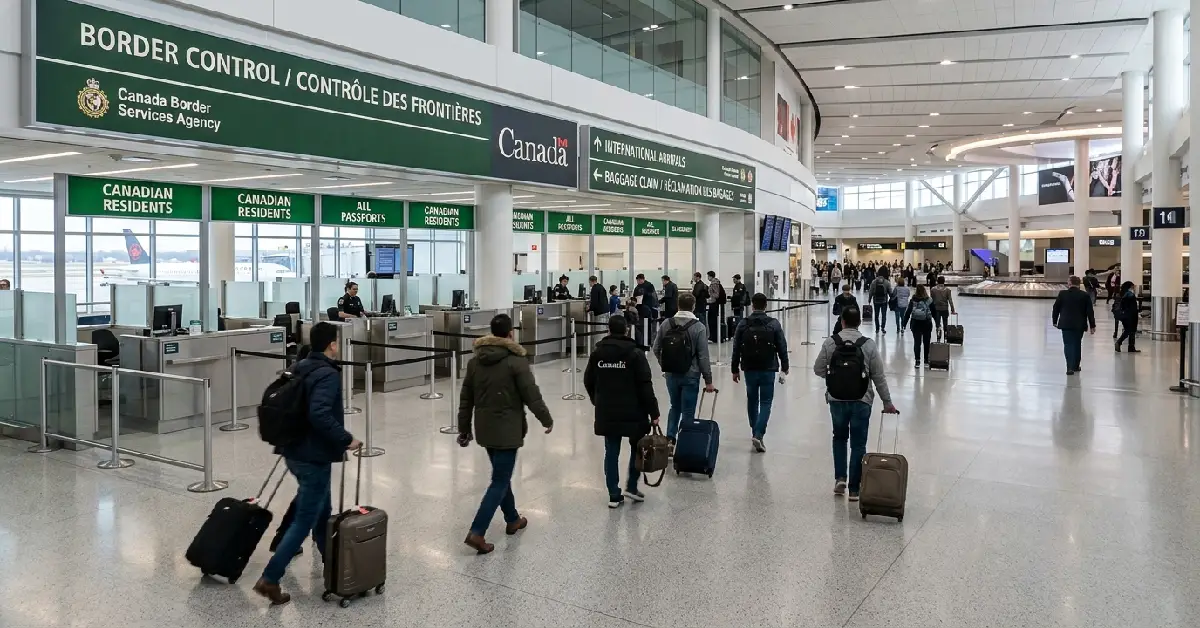
Canada’s approach to pre-arrival declarations has shifted considerably since the COVID-19 era.
ArriveCAN itself is no longer mandatory for most tourists. But the Advance Declaration feature, Canada’s digital customs submission tool, remains active, genuinely useful, and worth using if you want a faster arrival experience. Submit your customs and immigration information up to 72 hours before landing, and you unlock access to express lanes and eGates at eligible airports including Montreal-Trudeau (YUL). That’s a real time saving during busy international arrival periods.
Skip the Advance Declaration and you’ll fill out the same information at an airport kiosk or on a paper Declaration Card handed out on the plane. Either way, all travelers entering Canada must declare:
- Cash or monetary instruments above CAD $10,000
- Restricted or prohibited items, firearms, certain fresh foods, plants, animal products
- Any commercial goods
Common Reasons Canada Tourist Visa Applications Get Refused
Canada’s visitor visa refusal rate has climbed sharply in recent years. IRCC data shows the overall TRV refusal rate hit approximately 54% in 2024, some regions, including parts of South Asia, reported rates above 70%. Understanding what drives rejections is the clearest path to avoiding them.
The most common reasons for Canada tourist visa rejection in 2026:
- Weak home country ties, The officer couldn’t find enough evidence that the applicant would leave before their authorized stay expired
- Questionable financial documentation, Low balances, inconsistent history, or that telltale large pre-application deposit
- Vague travel purpose, Applications with no real itinerary, no specific reason for choosing Canada, no credible plan
- Undisclosed prior refusals, Hiding a previous visa rejection from Canada or another country; Canada’s Global Case Management System often catches this
- Incomplete or inconsistent documentation, Missing a signature, mismatched dates, low-quality scans that officers can’t properly verify
- Prior overstays, A history of overstaying in Canada or any partner country raises the probability of refusal dramatically
- Document authenticity concerns, Any application carrying documents that look altered or inconsistent with records gets flagged immediately, and reapplication becomes significantly harder
On reapplying after a Canada tourist visa refusal in 2026: there’s no mandatory waiting period. You can submit a new application the next day if you want. But submitting the same file, even slightly revised, almost always produces the same outcome. Read your IRCC refusal letter carefully, identify every specific concern the officer raised, address each one with concrete documentation, and submit a fundamentally stronger application the second time around.
2026 Health and Border Measures Worth Knowing
One active health update that applies to a specific group: travelers who visited the Democratic Republic of the Congo, Uganda, or South Sudan in the 21 days before arriving in Canada now face mandatory health assessment upon arrival, due to an active Ebola outbreak. Canada’s CBSA enforces this measure until August 29, 2026. Foreign nationals currently residing in those three countries cannot travel to Canada at all during this period.
This restriction does not touch travelers from any other country. And to be clear: Canada lifted all COVID-19 era travel restrictions, vaccination requirements, testing mandates, quarantine rules, permanently. None of those apply in 2026.
Proven Strategies to Strengthen Your Application
For eTA travelers:
- Only ever apply at canada.ca/eta, the official Government of Canada website. Third-party sites charge more and provide nothing extra
- Apply the moment you have confirmed travel dates; most eTAs clear within minutes, but a small percentage require additional review that can take days
- Carry your eTA confirmation email to the airport even though the authorization links automatically to your passport, it’s useful if questions arise at the gate
For visitor visa (TRV) applicants:
- Start assembling your documents 2–3 months before you plan to travel, not the week before
- Write your purpose of visit letter as if you’re explaining your plans to a skeptical stranger. Be specific: where you’re going, why, who you’re visiting, and when you’re leaving
- If a Canadian host is involved, ask them to write a detailed Canada tourist visa invitation letter that includes their immigration status, home address, relationship to you, and confirmation that they’ll support your visit
- Include previous passports that show international travel stamps, prior visa approvals from the US, UK, or Schengen countries tell an officer that other governments have vetted you before
- Never pad your bank balance artificially right before applying; a 6-month history of normal, stable finances outweighs a sudden large deposit every time
At the border:
- Answer questions clearly, honestly, and consistently with your application
- Carry printed copies of your key documents, itinerary, hotel bookings, return flights, even if you have digital versions
- Know your own trip. Border officers sometimes ask specific questions about your plans; vague answers raise suspicion
Pros and Cons of Canada’s Tourist Entry System
Where the system works well:
- The eTA is genuinely excellent, CAD $7, valid for 5 years, processed in minutes for most applicants
- Approved multi-entry visitor visas can cover up to 10 years, giving frequent travelers significant long-term value
- Canada eliminated all COVID-19 health entry requirements permanently, no vaccination proof, no tests, no declarations
- IRCC publishes live, country-specific processing time data publicly, you always know roughly where you stand
Where the system creates friction:
- Processing times for visa-required countries remain long and inconsistent, making planning difficult for travelers from Nigeria, Pakistan, and parts of South Asia
- High refusal rates in certain regions, particularly for first-time applicants, mean that a single poorly assembled application can derail months of planning
- Biometrics appointments at VACs book out weeks ahead during peak periods, adding wait time that applicants often underestimate
- Border officers hold final authority over authorized stay length, even a valid, properly issued visa doesn’t guarantee the entry you expect
Conclusion
Knowing the current entry requirements for tourists to Canada before you commit to bookings, not after , is what separates smooth arrivals from expensive disasters. The framework itself is logical: visa-exempt nationals use the quick eTA, everyone else goes through the TRV process. But the difference between a successful application and a refusal nearly always comes down to preparation, genuine documents, consistent financial history, credible home ties, and enough lead time to absorb delays without scrambling.
Canada draws tens of millions of tourists every year. The entry system exists to facilitate that flow while maintaining integrity. Meet it seriously, prepare your file properly, and the current entry requirements for tourists to Canada become far less intimidating than they might first appear. Your Canadian trip starts the moment you open that application,treat it that way.
Frequently Asked Questions (FAQ)
Do US citizens need a visa or eTA to enter Canada as tourists in 2026?
No. US citizens need neither a visa nor an eTA. A valid US passport covers air, land, and sea entry. Americans can stay up to 6 months per visit, with border officers holding discretion to extend this to 1 year under the right circumstances.
How long does Canada visitor visa processing take in 2026?
It depends on where you apply from. IRCC data from April 2026 puts Indian applicants at roughly 27 days, Nigerian applicants at 85+ days, and Filipino applicants at 4–8 weeks. Always check IRCC’s live processing time tool at ircc.canada.ca for your specific location, and submit your application at least 3 months before your travel date.
What documents do I need for a Canada tourist visa application?
You need a valid passport, the completed IMM 5257 form, two passport photos, 3–6 months of bank statements, proof of employment or enrollment, a travel itinerary, and a purpose of visit letter. Property records, family dependency proof, and an invitation letter from a Canadian host all strengthen the file considerably.
Can I reapply for a Canada tourist visa after a refusal?
Yes, Canada sets no mandatory waiting period after a TRV refusal. What you cannot do is reapply with the same application and expect a different result. Read your IRCC refusal letter thoroughly, address every concern the officer identified with stronger evidence, and submit a materially improved file.
Is ArriveCAN still required for tourists entering Canada in 2026?
No. ArriveCAN is no longer mandatory for most travelers. That said, submitting an Advance Declaration voluntarily, up to 72 hours before landing, gives you access to express lanes and eGates at eligible airports. It’s optional but worth doing for a faster arrival experience.