
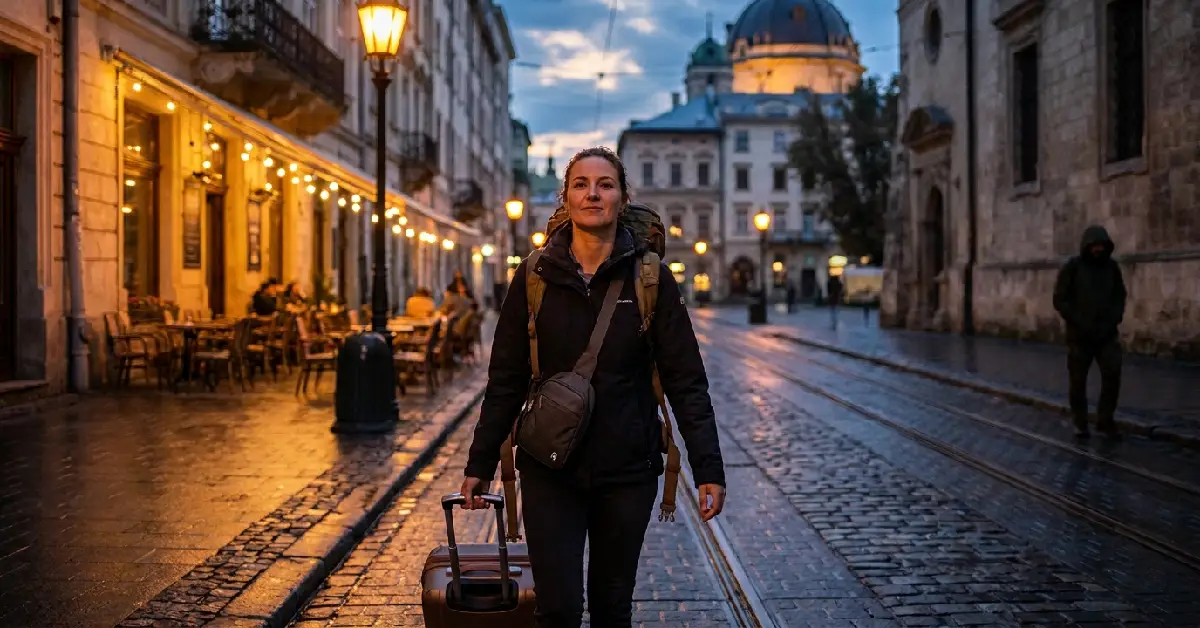
The best women solo travel Europe safety tips don’t come from someone who breezed through Paris on a group tour and called it solo travel. They come from the woman who got followed through Trastevere at 10:47 PM, who watched a man stand outside a corner shop window waiting for her to come out, and who learned, through that specific, stomach-dropping, twelve-minute ordeal, exactly what actually works when things go sideways.
That woman is me. I’ve traveled solo through 11 European countries over four years. I’ve had my card cloned in Prague, dodged a fake taxi at Charles de Gaulle, and sat in a Barcelona pharmacy for twenty minutes pretending to shop for sunscreen while a man outside finally gave up and left. None of that is in the Instagram version of solo travel. All of it shaped how I actually move through Europe now.
To be clear, this guide is not a reassurance piece. Europe is safe for solo women, the Global Peace Index 2024 ranks five European nations in the top ten safest countries on Earth. However, safe doesn’t mean identical everywhere, and prepared doesn’t mean paranoid. What it means is knowing the difference between a quiet Lisbon side street at midnight and the area around Roma Termini at rush hour, and adjusting accordingly.
That’s what these women solo travel Europe safety tips are built on. Specifics. Experience. The things that don’t make it into the pastel-toned travel posts.
What Nobody Tells You About Solo Female Travel Safety in Europe
Here’s the uncomfortable truth: most travel safety advice for women is written to be reassuring, not useful.
“Trust your instincts.” Sure. “Be aware of your surroundings.” Helpful, thanks. “Research your destination.” What does that mean, exactly, read a Wikipedia article and look at some photos?
In reality, the advice that actually changes what happens to you is specific. Specifically, it has names and locations and exact sequences of action. Rather, it was learned the hard way by someone who was actually there, not assembled from other blog posts to fill a content calendar.
Europe’s tourist zones concentrate risk in predictable, documented ways. Pickpocketing in Europe accounts for approximately 60% of all tourist-related crime reported to authorities, according to Eurostat crime data. Moreover, the majority of that theft happens in a handful of specific locations, not spread evenly across cities, but clustered at train stations, metro lines, and tourist landmarks where distraction is built into the environment.
Knowing that changes how you walk through those places. It changes what you carry and where. Consequently, the rest of your trip, the 95% of it that happens nowhere near those locations, becomes genuinely free.
The Safety Breakdown by Country: Honest, Not Optimistic
Based on the Global Peace Index 2024, Numbeo Crime Index, and the Women’s Travel Safety Index published annually by Solo Female Travelers:
| Country | Rating | The Real Picture |
|---|---|---|
| Iceland | ⭐⭐⭐⭐⭐ | #1 on GPI for over a decade. Near-zero violent crime. Almost no tourist-targeting scams. |
| Portugal | ⭐⭐⭐⭐⭐ | Lisbon and Porto rank top-5 in the Women’s Travel Safety Index. Warm and walkable. |
| Denmark | ⭐⭐⭐⭐⭐ | Safe nightlife, high English proficiency, cycling infrastructure removes transport risk. |
| Switzerland | ⭐⭐⭐⭐⭐ | Very low petty crime. Cities are easy to navigate alone. Expensive but worth it for a first trip. |
| Ireland | ⭐⭐⭐⭐½ | English-speaking. Pub culture makes solo socializing natural rather than awkward. |
| Austria | ⭐⭐⭐⭐½ | Vienna consistently ranks among the most liveable and safest cities in the world. |
| Netherlands | ⭐⭐⭐⭐ | Tolerant cities, great cycling. Minor pickpocket risk in Amsterdam’s tourist corridors. |
| Spain | ⭐⭐⭐⭐ | Brilliant for building connections. Documented pickpocket risk in Barcelona and Madrid tourist zones. |
| Italy | ⭐⭐⭐⭐ | Beautiful and welcoming. Scam and theft risk is concentrated, not general. Know the spots. |
| France | ⭐⭐⭐⭐ | Paris around the Eiffel Tower and Gare du Nord needs specific vigilance. Everywhere else, far calmer. |
Nevertheless, the tier-four countries are not dangerous destinations. They require sharper attention in specific moments and locations. That’s an important distinction, and one that generic safety rankings tend to flatten. Understanding it is the difference between useful women solo travel Europe safety tips and advice that simply makes you nervous for no reason.
Solo Female Travel Europe: Safety Preparation That Actually Matters
Every solid set of women solo travel Europe safety tips starts before you ever board the plane. Here’s what that preparation actually involves.
Stop “Researching” and Start Reading the Right Sources
Generic travel blogs are written for clicks. Government advisories, however, are written for accuracy. Before any trip, bookmark the one relevant to your passport: the UK Foreign, Commonwealth & Development Office, the US State Department, or Australia’s Smartraveller. These are updated in real time, not annually, not seasonally. They reflect what’s happening in a city this week.
Then go one level deeper. The Solo Female Travelers Facebook group has 1.8 million members and city-specific threads where women post field reports from the current week. Someone was in your next destination ten days ago. Her account is worth twenty polished articles.
Your Itinerary Share Protocol – Specifically, Not Vaguely
First, two people at home need your full itinerary before you land. Not “I’m going to Italy.” Hotel names, addresses, check-in dates, and one contact person at each accommodation. If plans change, a thirty-second message covers it.
TripIt automatically syncs with your booking confirmation emails and generates a shareable live link. I send mine to my sister before every departure. She doesn’t obsessively track it, but if I go quiet and miss a check-in message, she knows exactly where to start. That matters more than any safety gadget you can buy.
Travel Insurance: The Exclusions Are What You’re Actually Buying
Every policy sounds comprehensive until you read what it doesn’t cover. Medical evacuation from Montenegro’s coast, a stolen laptop in Kraków, a cancelled flight in peak season, these costs are real, and they arrive when you’re already stressed. World Nomads and SafetyWing are consistently rated for solo travelers. Therefore, read the exclusions before purchasing. The small print is precisely where coverage disappears.
Accommodation Safety Tips Every Solo Female Traveler in Europe Needs
Generally, most travel guides treat accommodation as a preference question. It isn’t. For women solo travel Europe safety, where you sleep has a direct, practical effect on how secure you feel, and how secure you actually are.
The Hostel Dorm Test: A Core Women Solo Travel Europe Safety Tip
Female-only dorms exist in most mid-to-large European cities. Generator Hostels, St. Christopher’s Inns, and Wombats all offer them, and they’re categorically different from mixed dorms. However, the star rating tells you almost nothing useful. Instead, read recent reviews written specifically by women. Look for comments on locker quality, bathroom access at night, staff response after 10 PM, and whether the common space feels welcoming or hollow. Those details never surface in aggregate scores.
Above all, bring a combination padlock. Combination, not key – because you cannot lose a code.
What Hotel and Airbnb Reviews Don’t Tell You
For hotels: ask for a room on a mid-level floor. Not ground level, which is accessible from outside. Not the top floor, which adds evacuation time. Mid-floor, near the elevator, not at the far end of a long corridor. Most front desk staff will accommodate this without blinking.
When you arrive, test the door lock and window latch immediately. In smaller independent hotels across Eastern and Southern Europe, these are sometimes broken. You’re paying for a secure room, ask to switch. In short, be matter-of-fact. It works.
For Airbnb, Superhost status with 50+ reviews is the floor, not the ceiling. The real signal is whether solo women have reviewed the listing, specifically what they noticed about the neighborhood at night and whether key access was discreet. Subsequently, filter by most recent. Read between the lines.
The European Scams Every Woman Should Know Before Solo Travel in Europe
I was in Barcelona’s Gothic Quarter in 2022 when a woman approached me with a clipboard and a sense of emergency. I knew immediately, not because I’m especially clever, but because I’d read about this exact scam three days before landing, I kept walking. The woman behind me did not keep walking. She stopped, and thirty seconds later was patting her pockets.
In fact, knowing these scams in advance is the entire protection. Furthermore, none of them are sophisticated. Yet all of them rely on one moment of distraction. These are the incidents that make up the realistic risk picture in women solo travel Europe safety tips, not dramatic, not rare, and entirely avoidable once you know what to look for.
The Friendship Bracelet
A stranger ties a string bracelet on your wrist without asking, then frames the payment demand as a “gift” that became a transaction. Walk without stopping. Say no once, firmly. Subsequently, don’t apologize. Concentrated near: Sacré-Cœur in Paris, Camp Nou surrounds in Barcelona, Ponte Vecchio in Florence.
The Petition Clipboard
A group approaches with clipboards and urgent body language. Others are working your bag from behind. Common near: the Eiffel Tower base, the Louvre entrance, Rome’s Spanish Steps. Never stop walking for this.
The Distraction Spill
Someone drops something or spills near you, designed to pull your attention downward. A second person moves on your bag from behind. Documented regularly on La Rambla in Barcelona, outside Naples Centrale, and at Marseille’s Old Port.
The Airport Taxi Setup
Unofficial drivers at arrivals hold signs and project confidence. They’re unlicensed, and the fare is negotiated mid-journey. Therefore, always use the marked official taxi rank or pre-book Bolt before landing.
ATM Card Skimming
Devices fitted over card slots, almost always on standalone ATMs in tourist areas rather than machines inside bank branches. Use ATMs inside bank lobbies during opening hours. Cover your PIN. Better still, use contactless: Apple Pay and Google Pay work at most European retailers now.
Transport Safety Tips for Women Solo Traveling in Europe
Transport is one of the most overlooked chapters in any women solo travel Europe safety tips guide, yet it’s where the majority of documented theft incidents actually begin.
Women Solo Travel in Europe: Overnight Train Safety Tips
European rail is genuinely exceptional. Overnight trains are one of the best ways to move between cities, and they’re overwhelmingly safe, with a few specific habits applied. Book a coupé, the 4-to-6-person compartment with a sliding door, rather than an open-carriage seat. Lock the door from inside. Store your bag on the rack directly above you, not across the compartment, where retrieving it would require movement that wakes you. Passport and bank cards stay in a money belt under your clothing all night.
The Interrail app shows carriage layouts before you board, use it to select the carriage nearest the conductor.
City Metro Systems: Where Pickpockets Actually Work
The most documented high-risk metro lines in Europe, based on incident reports consolidated by Eurostat: Paris Line 1 between Châtelet and Charles de Gaulle–Étoile, Barcelona’s L3 between Passeig de Gràcia and Liceu, and Rome’s Line A between Termini and Ottaviano. In these environments, specifically: bag in front of you, zip closed, hand resting naturally on it. Not anxious, just present. There’s a meaningful difference.
Missed the last metro? Bolt and Uber cover most European cities for €5–15. Take it. Ultimately, the calculation is that simple.
When It Goes Wrong: The Rome Sequence, Specifically
So, back to Trastevere. The man had taken six of the same turns I had. My options were not “panic” or “pretend everything is fine.” My option was movement, toward light, toward people, toward a door I could walk through.
I stepped into an alimentari. Two people inside, shelves of olive oil and wine. Rather than standing near the entrance looking anxious, I picked up a bottle from the back shelf and watched the window. The man stood outside. He waited. Then he left.
After twelve minutes, I bought the wine. The woman behind the counter understood in a single look what had happened, she’d seen it before. Finally, her husband walked me to my street.
Here is what that experience taught me, precisely: populated spaces are your most powerful tool. Any open shop, café, hotel lobby, pharmacy, or restaurant is a legitimate refuge. Walk in without ceremony. Generally, people understand faster than you expect. If you’re genuinely threatened, call 112, the universal EU emergency number, which works from any phone, even without a SIM card. Furthermore, saying clearly and loudly “this person is following me” in a crowded space removes the silence that makes following someone low-risk. Most people who do this are counting entirely on your quiet.
That response, the alimentari, the watching, the waiting, is the practical application of the most important women solo travel Europe safety tip I know: move toward people, not away from the problem.
Women Solo Travel Europe Safety Tips: Money, Emergency Numbers and Gear
Solo Female Travel Europe Safety: Your Financial Layer
Managing your finances correctly is one of the most underrated women solo travel Europe safety tips, yet it’s the layer that fails people most often when something actually goes wrong. Always. I use Revolut as my primary travel card and keep a Wise card in a separate interior pocket. Both send real-time transaction notifications, if either is used without my knowledge, I know within seconds and can freeze it instantly from the app. Additionally, carry €50–80 in cash as backup, particularly in Eastern Europe where smaller towns still operate heavily on cash.
Also, tell your home bank your travel dates before you leave. Without that, a foreign-spending pattern can trigger an automatic account freeze, a solvable problem that is genuinely awful at 11 PM in an unfamiliar city.
Emergency Numbers – Save Before You Land
112 works across every EU member state. Police, fire, medical, all connected. It operates from any phone, even without a SIM card, and English-speaking operators are available in most countries.
| Country | Police | Medical | Universal |
|---|---|---|---|
| All EU Countries | 112 | 112 | 112 |
| United Kingdom | 999 | 999 | 999 |
| Germany | 110 | 112 | 112 |
| Italy | 113 | 118 | 112 |
| France | 17 | 15 | 112 |
| Spain | 091 | 112 | 112 |
| Netherlands | 0900-8844 | 112 | 112 |
As a result, screenshot the local emergency number for each new city and keep it in your photos. Small habit. Significant difference in the moment.
The Packing List That Changes What Happens
Not a comprehensive gear list. Specifically the items that change outcomes.
- Wedge door alarm (~$10): Pressed under your hotel room door at night. Any movement triggers a 100dB alarm. It doesn’t make a room impenetrable, it makes a problem very loud, very fast. That’s the entire function.
- Combination padlock: For hostel lockers. Combination means one less object to lose.
- Anti-theft crossbody bag: Pacsafe and Travelon both make bags with slash-resistant straps, lockable zippers, and RFID-blocking panels. They look ordinary. They aren’t.
- 20,000mAh portable charger: A dead phone is a vulnerable phone. Non-negotiable.
- Offline city maps: Google Maps and Maps.me both support full city downloads via WiFi. In particular, do it before your flight. You will not always have data when you need navigation most.
- Passport photocopy – two copies: One digital, stored in Google Drive or Dropbox. One paper, kept in a different bag from your actual passport.
Where to Begin Your Solo Female Travel Europe Journey
If this is your first solo trip, or your first time in Europe alone, destination choice is one of the most underrated women solo travel Europe safety tips you’ll find. Some cities are simply more forgiving: easier to navigate, more English-friendly, with stronger solo travel communities already in place.
For instance, start in Lisbon. It consistently ranks in the top five on the Women’s Travel Safety Index. Low crime, walkable neighborhoods, excellent English, and a hostel culture so oriented toward solo female travelers that you’ll feel expected from the moment you arrive. The trams teach you how to manage pickpocket-risk transport. The hills teach you to read a neighborhood quickly. It’s the best education in solo travel there is.
Alternatively, consider Reykjavik. Expensive, yes. Crime-free in any meaningful sense, also yes. Small enough to master in two days, relaxed enough that eating alone at a restaurant draws zero attention. A genuinely restorative place to start.
Similarly, Dublin works well. English-speaking, warm without being overwhelming, manageable in scale. Pub culture means meeting other travelers is completely natural, no social effort required.
Once you’ve built your own rhythm in one of these cities, the skills transfer everywhere. The confidence travels with you. So does the muscle memory of walking with direction, keeping your bag in front, and knowing which door to walk through if you need twelve minutes to wait someone out.
Conclusion
These women solo travel Europe safety tips exist for one reason: to give you enough specific, usable knowledge that fear stops being the loudest voice in the room.
Indeed, Europe is not a continent that needs to be survived. It’s one of the most extraordinary, accessible, female-friendly travel regions in the world. The risk is real in specific places and moments, and it is manageable with the right preparation, the right habits, and the right understanding of where that risk actually lives.
First, pack the padlock. Download the offline maps. Then split your cards. Save 112. Walk like you know exactly where you’re going, even when you’re figuring it out as you go.
The Trastevere I was in that night, after the alimentari, after the husband walked me to my street, was golden and quiet and one of the most beautiful places I’ve ever stood. Nevertheless, I went back the next night. Arrived earlier, left before 10 PM, and ate the best cacio e pepe of my life alone at a corner table.
That’s what prepared feels like. Go find your version of it.
FAQ
What are the most important women solo travel Europe safety tips for first-time solo travelers?
The most impactful are: share a detailed itinerary with two people before you land, use a real-time notification travel card like Revolut or Wise so you know immediately if a card is used without your knowledge, carry a wedge-style door alarm for hotel rooms, download offline city maps before flying, and learn the five most common tourist-targeting scams in Europe before you arrive. First-time solo travelers in Europe should also start in a beginner-friendly destination: Lisbon, Reykjavik, or Dublin each offer low crime, strong English proficiency, and established solo female traveler communities.
Is Europe safe for solo female travelers in 2025?
Yes. The Global Peace Index 2024 ranks Iceland, Ireland, Denmark, Portugal, and Austria among the 15 safest countries in the world. Violent crime targeting tourists is rare across the continent. The primary risks, pickpocketing and distraction scams, are concentrated in specific tourist-dense locations and are largely preventable through awareness and practical habits. Millions of women travel solo through Europe every year without significant incident.
Which European country is safest for women traveling alone?
Iceland has ranked first on the Global Peace Index for over a decade and consistently tops solo female traveler safety surveys. It combines near-zero violent crime with a small walkable capital, high English proficiency, and a culture where solo women attract no unusual attention. Portugal, Denmark, Switzerland, and Ireland also rank consistently in the top tier based on crime data and the Women’s Travel Safety Index.
What scams specifically target solo female travelers in Europe?
The five most documented are: the friendship bracelet scam near Sacré-Cœur, Ponte Vecchio, and Camp Nou surrounds; the petition clipboard distraction used near the Eiffel Tower, Spanish Steps, and the Louvre; two-person distraction spills on La Rambla, at Naples Centrale, and Marseille’s Old Port; unlicensed airport taxi approaches at major European airports; and ATM card skimming devices on standalone machines in tourist zones. According to Eurostat crime data, pickpocketing accounts for the majority of tourist-related theft across Europe, and it clusters at these specific locations.
What should I carry for personal safety as a solo female traveler in Europe?
The items that meaningfully change outcomes: a wedge-style door alarm (~$10) for hotel rooms, a combination padlock for hostel lockers, an anti-theft crossbody bag with slash-resistant straps from Pacsafe or Travelon, a 20,000mAh portable charger, offline city maps downloaded before landing, two separate travel cards (Revolut and Wise) stored in separate locations, and two copies of your passport, one digital in cloud storage, one paper kept apart from the original.