
If you’re searching for unforgettable things to do in Madrid Spain with family, you’ve landed in the right place. I can still vividly recall stepping off the metro at Retiro with my own kids for the first time. We were jet-lagged, slightly overwhelmed, and I genuinely wondered if a European capital could really deliver for a seven-year-old who just wanted ice cream and a swing set. Within 48 hours, however, Madrid had completely won us over.
The city doesn’t just tolerate children; it actively welcomes them. From waiters who bring out special plates for toddlers without being asked to grandmothers who smile and strike up conversations on park benches, Madrid operates on a rhythm that syncs naturally with family life. Moreover, you won’t find the frantic pace of London or the tourist saturation of Paris here. What you will find is a walkable, sunny, and genuinely warm destination where multigenerational travel feels less like work and more like an actual vacation.
Table of Contents
ToggleWhy Madrid is Perfect for Family Trips
Some European cities require a tactical mindset to navigate with children. In other words, you need carefully planned routes, constant vigilance, and an exit strategy for every museum meltdown. By contrast, Madrid asks for none of that. The Spanish capital has mastered the art of being simultaneously sophisticated and completely unpretentious.
Safe, Walkable, and Full of Kid-Friendly Attractions
The first thing you’ll notice is how compact the historic center feels. Puerta del Sol, Plaza Mayor, the Royal Palace, and the Opera district all sit within comfortable strolling distance of one another. Sidewalks are wide, pedestrianized streets are plentiful, and, perhaps most importantly for parents, drivers actually stop at crosswalks. This is a small miracle if you’re used to more aggressive traffic cultures.
In addition to the layout, safety is another quiet advantage. Madrid consistently ranks among Europe’s safer capitals. Late dinners mean streets stay lively well past 10 PM, creating a natural neighborhood watch effect. We never felt uncomfortable walking back to our apartment after a late churros run, even with tired kids in tow.
Furthermore, Madrid simply likes children. Playgrounds dot nearly every neighborhood square. Similarly, restaurants keep odd hours that ironically work better for jet-lagged toddlers. And finally, the climate, with 300-plus sunny days annually, means outdoor plans rarely get rained out.
Best Seasons to Visit with Family
Timing matters enormously when traveling with children. Summer in Madrid is intense. July and August routinely push temperatures above 35°C (95°F), and many locals flee for the coast. Consequently, if your family trip falls during these months, plan indoor or water-based activities between 2 PM and 6 PM. Embrace the Spanish siesta rhythm, air conditioning and a nap will save everyone’s sanity.
Spring (March through May) and autumn (September through November) offer ideal conditions. Temperatures hover between 15°C and 25°C (60°F to 77°F), perfect for long park afternoons and outdoor dining. October, in particular, brings a certain magic: golden light, fewer crowds, and accommodation prices that dip noticeably after the September peak.
On the other hand, winter deserves consideration too. Madrid’s holiday season transforms Plaza Mayor into a festive Christmas market. Additionally, January and February offer the lowest hotel rates of the year. Daytime temperatures often reach 10-12°C (50-54°F), chilly but manageable with proper layers. As a result, if you can brave the cold, you’ll have museums and attractions largely to yourselves.
Key seasonal takeaways:
- Spring (Mar-May): Ideal weather, moderate crowds; book 2-3 months ahead.
- Summer (Jun-Aug): Hot, busy, expensive; plan indoor midday breaks.
- Autumn (Sep-Nov): Perfect conditions, lower prices after September.
- Winter (Dec-Feb): Coldest, cheapest, magical holiday atmosphere.
Top Family Attractions in Madrid
Madrid rewards families who mix iconic sights with pure play. Specifically, the key is knowing which landmarks genuinely engage children and which ones are better saved for an adults-only return trip.
Royal Palace of Madrid
Let’s be honest, dragging a nine-year-old through endless gilded rooms while reading placards about 18th-century monarchs is a recipe for disaster. Nevertheless, the Royal Palace works differently. The sheer scale alone captures attention. After all, it boasts over 3,400 rooms, making it Western Europe’s largest functioning royal palace.
What sold it for my kids was the armory. Swords, suits of armor sized for actual knights, and elaborate crossbows, this is the stuff of bedtime stories made real. Meanwhile, the pharmacy room, with its ancient ceramic jars and mysterious tinctures, sparked questions for days afterward. Likewise, the views from the courtyard across to the Sabatini Gardens provide a natural breather between interior sections.
Practical tips for families:
- Book online tickets in advance, the queue can stretch 45+ minutes in peak season.
- Visit before 11 AM or after 4 PM to avoid tour group clusters.
- Free admission for children under 5; reduced rates for ages 5-16.
- Skip the guided tour unless your kids are exceptionally patient; self-guided lets you set the pace.
- The changing of the guard (Wednesday and Saturday, weather permitting) offers a free spectacle outside.
El Retiro Park
If I could recommend just one place for things to do in Madrid Spain with family, El Retiro would be it. This 125-hectare green heart beats at the center of Madrid’s family life. Not only is it expansive, but it is also incredibly diverse in its offerings.
The park reveals itself in layers. Enter from the Puerta de Alcalá side and you’ll encounter the formal gardens and the stunning Palacio de Cristal. Then, continue deeper and you’ll discover over ten distinct playground areas, each with a slightly different character. Some cater to toddlers with small slides and soft surfaces. In contrast, others offer more challenging climbing structures for older kids.
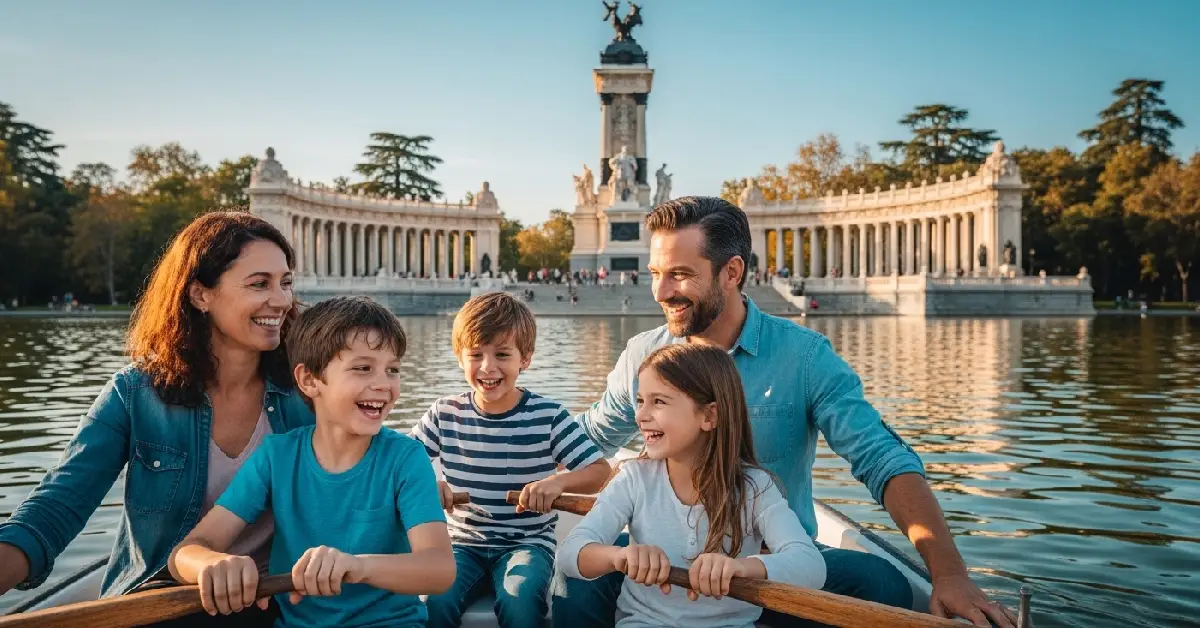
Beyond the playgrounds, there’s the lake. The Estanque Grande, presided over by the grand Alfonso XII monument, rents rowboats by the half-hour. On a sunny afternoon, the water fills with families navigating slightly chaotically while buskers play accordion nearby. It’s pure joy, no translation required.
Wildlife adds another dimension. Peacocks roam freely near the Rosaleda (rose garden), their iridescent tails drawing delighted gasps. Meanwhile, turtles sun themselves on rocks in the smaller ponds. My daughter spent 20 minutes tracking a particularly bold peacock, convinced she could get close enough to touch it. Ultimately, she couldn’t, but the pursuit itself was the adventure.
Retiro with kids checklist:
- Rowboat rental: approximately €6-8 for 45 minutes.
- Puppet shows at the Teatro de Títeres (weekend afternoons, free).
- Bicycle rentals available at multiple park entrances.
- Multiple cafés with kid-friendly options and bathrooms.
- Street performers often gather near the lake on weekends.
Madrid Zoo Aquarium
Located within the vast Casa de Campo park, Madrid Zoo Aquarium strikes a balance between conservation education and pure entertainment. Furthermore, it’s an easy escape from the city center bustle.
The zoo spans 20 hectares and organizes exhibits by continent. The giant panda enclosure deserves special mention. Madrid’s zoo has achieved notable success with panda breeding, and watching these animals lounge contentedly while munching bamboo fascinates visitors of all ages. In the meantime, dolphin shows run multiple times daily. Additionally, the aquarium section features a walk-through tunnel where sharks and rays glide overhead.
Zoo planning notes:
- Full exploration takes 4-5 hours; pack snacks and water.
- Dolphin show schedules change seasonally, check upon arrival.
- The children’s farm area allows supervised interaction with goats and sheep.
- Combination tickets with Parque de Atracciones offer better value for multi-day visits.
- Metro stop: Casa de Campo (Line 5, Line 10).
Fun Outdoor Activities for Kids
Madrid’s outdoor offerings extend far beyond the major attractions. In fact, some of our best family moments happened during unplanned hours in squares and playgrounds.
Boat Rides at Retiro Park Lake
The rowboat rental at Retiro deserves its own entry because it exemplifies what makes Madrid special for families. There’s something inherently democratic about this experience. Tourists and locals alike queue for the same wooden boats, equally inept at steering, equally delighted when they finally figure it out.
The lake isn’t large. You can cross it in perhaps five minutes of determined rowing. However, that’s not the point. The point is drifting, watching the Alfonso XII monument reflect in rippling water, spotting turtles along the edge, and letting someone else take charge for a while.
Rentals cost roughly €6-8 depending on weekday versus weekend rates. Arrive before 11 AM to minimize wait times. Moreover, if your kids are too young to row, the solar-powered tour boat offers a drier alternative with commentary in multiple languages.
Playgrounds and Picnic Spots
Spanish playground design deserves more international recognition. Clearly, these aren’t the sad plastic structures plopped onto wood chips that plague American suburbs. Instead, Madrid’s play areas incorporate climbing walls, zip lines, imaginative wooden structures shaped like ships or castles, and, crucially shade.
The Madrid Río project transformed the Manzanares riverfront into a linear park stretching kilometers. As a result, it’s studded with innovative play zones. Each area targets different age groups. For example, the Arganzuela section features a massive slide complex that kept my kids occupied for over an hour. Further south, near Matadero, you’ll find water play features that provide blessed relief on hot afternoons.
For picnics, Sabatini Gardens adjacent to the Royal Palace offers manicured lawns with palace views. Alternatively, Parque del Oeste provides more secluded spots and a small cable car (Teleférico) that connects to Casa de Campo with panoramic city views. A word about Spanish picnic culture: bread, jamón, cheese, olives, and fruit from any neighborhood market create an instant feast for under €15.
Best playground picks:
- Madrid Río (Arganzuela section): Slides, climbing structures, water play.
- Parque de Berlín: Vintage charm, large sand area, shaded benches.
- Plaza de España (recently renovated): Modern equipment, central location.
- Quinta de los Molinos: Open space, less crowded, beautiful almond blossoms in February.
Street Performances in City Squares
Puerta del Sol and Plaza Mayor pulse with street performers throughout the day. Living statues, a painted conquistador frozen mid-gesture or a golden Egyptian pharaoh, captivate younger children. Meanwhile, the occasional flamenco guitarist draws impromptu crowds that clap along regardless of language barriers.
One practical note: Plaza Mayor restaurants charge premium prices for the view. Therefore, eat elsewhere, then let kids watch performers while you nurse a coffee from a nearby café. The square’s sheer theatricality, 400 years of markets, bullfights, and public ceremonies embedded in its cobblestones, requires no admission fee.
Museums Kids Will Actually Enjoy
Most families approach Madrid’s museum scene with understandable caution. The Prado houses one of Europe’s finest art collections. However, it’s also vast, crowded, and filled with works that require significant context to appreciate. Consequently, dragging reluctant children through it benefits no one.
Fortunately, Madrid offers smarter alternatives, museums designed with younger visitors in mind.
Museo Nacional de Ciencias Naturales
Natural history museums occupy a sweet spot for family travel. They combine wonder with enough educational substance to satisfy parents. Madrid’s National Museum of Natural Sciences delivers on both fronts. Moreover, the building itself dates to 1887 and retains that old-cabinet-of-curiosities atmosphere.
Exhibits cover geology, paleontology, biodiversity, and human evolution. The dinosaur section features impressive mounted skeletons alongside interactive displays explaining fossil formation. Upstairs, the Mediterranean ecosystem dioramas showcase wildlife most European children will recognize from family beach trips.
My son’s favorite? The megatherium, a prehistoric ground sloth the size of a small elephant. He still talks about it months later.
Visit tips:
- Allow 2-3 hours; the building is manageable without museum fatigue.
- Thursday afternoons offer free admission (crowds increase accordingly).
- Located near Nuevos Ministerios, well-connected by metro and bus.
- Gift shop stocks quality educational toys and books in multiple languages.
Interactive Exhibits and Science Zones
In addition to the natural sciences museum, Madrid offers several spaces embracing hands-on learning. Sweet Space operates more as immersive art installation than traditional museum. Giant candy sculptures and a ball pit that looks like a bowl of ice cream create an environment built for Instagram but genuinely fun for kids under 12.
Another option is The Wax Museum, which recently renovated its space near Plaza de Colón. While the historical figure section holds limited interest for young visitors, the dedicated children’s area keeps everyone engaged. Similarly, for families with soccer-obsessed children, LEGENDS: The Home of Football showcases historic jerseys and interactive exhibits. The 4D cinema and virtual reality zones provide excellent rainy-day entertainment.
Short Attention-Span Friendly Museum Tips
After years of museum visits with children, I’ve developed a few reliable strategies:
- The 45-minute rule. Most kids max out on focused museum attention after 45-60 minutes. Plan accordingly, hit 2-3 highlight galleries rather than attempting comprehensive coverage.
- Pre-visit bribes. The promise of post-museum churros has smoothed many a cultural outing. Name the reward upfront, then follow through.
- Scavenger hunt approach. Give each child a specific mission: “Find three paintings with dogs” or “Count all the swords.” This transforms passive viewing into active quest.
- Audio guide alternative. Download a few relevant YouTube videos beforehand and let kids watch on headphones if they lose interest. It is far better than a meltdown in a quiet gallery.
- Know when to fold. Some days, the museum just isn’t happening. Thankfully, Madrid has enough parks and plazas that you can pivot without guilt.
Best Food Experiences for Families
Spanish dining culture initially seems intimidating for families. Dinner starts at 9 PM and meals stretch for hours. Yet, then you notice something remarkable. The waiter just brought a toddler a small plate of olives without being asked. Similarly, the family with three kids under eight is laughing together over shared plates of croquetas. Spanish restaurants genuinely welcome children, not as an accommodation, but as natural participants in social dining.
Tapas Culture Explained for Kids
Tapas work brilliantly for families because they solve the kid-menu problem. Instead of committing to a single dish they might reject, children can sample small portions of multiple items. Most bars offer half-rations (media ración) for smaller appetites.
Kid-approved tapas starters:
- Croquetas: Crispy fried béchamel fritters, usually filled with ham or chicken.
- Tortilla española: The classic potato omelet, served room temperature in wedges.
- Patatas bravas: Fried potatoes with spicy tomato sauce (ask for sauce on the side).
- Jamón ibérico: Cured ham that even picky eaters often devour.
- Queso manchego: Mild sheep’s milk cheese, excellent with bread.
- Aceitunas: Simple olives, surprisingly popular with adventurous young palates.
Ordering strategy: Start with 2-3 plates. Let kids identify favorites, then order seconds. In this way, you prevent waste and empower children to guide the meal.
Family-Friendly Restaurants in Madrid
Certain restaurants particularly shine for family dining. Mercado de San Miguel near Plaza Mayor offers a covered market experience where everyone can choose their own adventure. It’s touristy, yes, and prices reflect the location. Nonetheless, the energy and variety justify at least one visit.
For a more local experience, La Latina neighborhood on Sunday mornings transforms into the city’s best casual food crawl. Families spill from bars onto the street, kids alternating between bites of tortilla and chasing pigeons.
Several restaurants specifically cater to families with supervised play areas. Alopeke near Retiro offers organic food and baby changing facilities. Meanwhile, La Excéntrica near the Royal Palace includes a weekend children’s area with monitors. Additionally, Mama Campo near Plaza de Olavide hosts occasional kids’ workshops alongside its organic-focused menu.
Chocolate con Churros Experience
No family trip to Madrid ends without chocolate con churros. This iconic pairing, thick, almost pudding-like hot chocolate served with crispy fried dough sticks, defines Spanish comfort food.
Chocolatería San Ginés, operating since 1894, remains the classic choice. The green-and-white tiled interior, open 24 hours, attracts everyone from post-club revelers to jet-lagged families. Expect queues at peak times, although the line moves efficiently. One order easily satisfies two young children; the chocolate is rich enough that moderation comes naturally.
For a less touristy alternative, Valor chocolaterías (multiple locations) offer table service and slightly less intense crowds. The chocolate quality matches San Ginés, and the menu includes gluten-free churros options.
Pro tip: Chocolate con churros makes an excellent breakfast on arrival day. The sugar-caffeine combination helps everyone push through jet lag until a reasonable local bedtime.
Day Trips from Madrid
Madrid’s central location and excellent rail network make day trips surprisingly feasible with children. Specifically, within an hour, you can step into medieval fortresses or walled cities that feel worlds away from capital bustle.
Toledo Medieval City Visit
Toledo sits just 30 minutes by high-speed train from Madrid’s Atocha station. The city, perched dramatically above the Tagus River, compresses centuries of history into a maze of cobblestone streets. As a result, kids respond to Toledo’s tactile qualities, the massive stone walls, the sword shops displaying gleaming replicas, and the marzipan vendors offering samples.
The Cathedral’s treasury contains a monstrance made from gold allegedly brought from the Americas. Interestingly, this detail captured my children’s imagination far more than architectural terminology ever could.
Toledo day trip essentials:
- Train from Atocha: 30 minutes, approximately €14 round-trip adult.
- Stroller warning: Cobblestone streets challenge even robust strollers; carriers work better for toddlers.
- The tourist train (Zocotren) provides an easy orientation loop with commentary.
- Marzipan from Santo Tomé: the city’s signature sweet.
- Morning trains are less crowded; return before the 6 PM commuter rush.
Segovia Castle Exploration
Segovia’s Roman aqueduct dominates first impressions, a 2,000-year-old engineering marvel built without mortar that still carries water today. Unquestionably, it’s the kind of sight that prompts genuine “how did they do that?” questions from children.
Beyond the aqueduct, Segovia’s Alcázar castle delivers pure fairy-tale architecture. The turrets and towers allegedly inspired Walt Disney’s Cinderella Castle. Inside, the armory and throne room satisfy medieval castle expectations. Climbing the tower (152 steps) rewards with panoramic views across the Castilian plain.
Segovia with kids:
- Train from Chamartín: 27 minutes by high-speed AVE; book ahead for best fares.
- The aqueduct viewpoint from Plaza del Azoguejo works best for photos.
- Cochinillo (roast suckling pig) is the local specialty, share one portion among family.
- Alcázar admission: children under 6 free, reduced rates ages 6-16.
- Combine with a visit to the nearby Mint museum if time allows.
Easy Train Travel Tips
Spanish high-speed trains (AVE) run efficiently and comfortably. Even so, family train travel benefits from preparation.
- Book online in advance through Renfe’s website or app. Fares increase as departure approaches.
- Family seating: Select “Mesa” (table seating) when available, four seats facing each other creates a contained space for games and snacks.
- Children under 4 travel free if sitting on a lap; purchase a child ticket if you want a guaranteed seat.
- Station navigation: Arrive 20-30 minutes before departure. Atocha and Chamartín stations require security screening.
- Pack entertainment: Download offline content before traveling; train WiFi remains inconsistent.
Transportation Tips for Families
Navigating Madrid with children requires different strategies than solo adult travel. On the bright side, Madrid’s public transportation ranks among Europe’s most family-accessible systems.
Metro Safety and Stroller Access
Madrid’s Metro impresses with its reach and frequency. Trains arrive every 3-5 minutes on most lines, and stations feature clear signage. For families, the system presents both advantages and challenges.
Stroller navigation: Not all stations include elevators. The Metro map identifies accessible stations with a wheelchair symbol. Therefore, plan routes accordingly. Transferring at non-accessible stations means hauling strollers up stairs.
Safety practices: Keep children close during boarding and exiting. Announcements warn of the gap between train and platform (“atención, estación en curva”). The gap on curved platforms can be significant enough for a small child’s foot to slip through.
Ticketing strategy: Purchase a Multi Card (Tarjeta Multi) and load 10-trip tickets (Metrobús). This avoids per-ride premium pricing. Children under 4 ride free; ages 4-11 qualify for reduced fares with a child Multi Card.
Hop-On Hop-Off Buses
Tourist buses divide travelers. Some dismiss them as overpriced and slow. However, for families with young children, they solve genuine problems. The open-top double-decker provides elevation that small kids lack when walking crowded streets. Additionally, commentary through provided headphones entertains older children while parents orient themselves.
Most critically, the bus eliminates the endless “my legs are tired” complaints that derail walking tours. Madrid offers two competing companies with similar routes and pricing. A 24-hour or 48-hour pass allows unlimited boarding. Strategic use: Ride the full loop once for orientation, then use the bus to connect major sites while resting small legs.
Walking Routes in Central Madrid
Madrid’s historic core rewards walking. The distance from the Royal Palace to Retiro Park spans roughly 3 kilometers, manageable for school-age children with strategic breaks.
Suggested family walking route:
- Start at Plaza de Oriente (Royal Palace views, playground).
- Walk through Plaza Mayor (street performers).
- Continue to Puerta del Sol (Kilometer Zero marker).
- Down Calle de Alcalá toward Plaza de Cibeles (impressive fountain).
- End at Retiro Park (playground reward).
This route takes 60-90 minutes with stops. Ideally, break it into morning and afternoon segments for younger children.
Budget Planning for Family Trip
Madrid occupies a comfortable middle ground among European capitals. Compared to Paris or London, it feels significantly more affordable. Nonetheless, understanding cost patterns helps families plan realistically.
Average Daily Cost
Based on 2025-2026 data, a family of four should budget approximately:
Budget-conscious approach (€150-200/day):
- Accommodation: Apartment rental or budget hotel (€80-120/night).
- Food: Market picnics, casual tapas bars, limited restaurant meals.
- Activities: Prioritize free attractions (parks, playgrounds, free museum hours).
- Transportation: Multi Card with 10-trip tickets, mostly walking.
Mid-range comfort (€250-350/day):
- Accommodation: Central hotel or quality apartment (€150-200/night).
- Food: Mix of restaurants and casual meals, daily churros.
- Activities: Paid museum entries, zoo or amusement park visit, one day trip.
- Transportation: Mix of Metro, occasional taxi for tired evenings.
Splurge experience (€400+/day):
- Accommodation: Premium hotel with family amenities (€250+/night).
- Food: Full-service restaurants, special dining experiences.
- Activities: Private family tours, multiple paid attractions.
- Transportation: Taxis when convenient, premium train seats for day trips.
Note: These figures exclude international flights. Seasonal variation significantly impacts accommodation costs. February averages nearly 40% cheaper than September.
Money-Saving Tips
Madrid offers numerous ways to stretch family travel budgets without sacrificing experience.
Accommodation savings:
- Book apartments with kitchens; breakfast and occasional dinners at home reduce food costs substantially.
- Neighborhoods slightly outside the core (Chamberí, Arganzuela) offer better value than Sol.
- January-February and November see hotel rates drop 30-50%.
Food savings:
- Menu del día: Fixed-price weekday lunch menus (€12-18) offer the city’s best dining value.
- Market shopping: Mercado de la Cebada provides fresh ingredients at local prices.
- Picnic culture embraced: Eating in parks is not just acceptable but celebrated.
Activity savings:
- Free museum hours: Prado (Mon-Sat 6-8 PM), Reina Sofía (Mon/Wed-Sat 7-9 PM).
- Park entertainment: Street performers and playgrounds cost nothing.
- City views: Círculo de Bellas Artes rooftop (€5) offers cheaper alternative to Faro de Moncloa.
Free Attractions
Madrid’s best free experiences often outshine paid alternatives.
- Retiro Park: All day, every day, zero euros.
- Templo de Debod: Ancient Egyptian temple, spectacular sunset views.
- Plaza Mayor: Living theater, always free.
- Changing of the Guard: Royal Palace, Wednesdays and Saturdays.
- Matadero Madrid: Contemporary cultural center, free exhibitions.
- Madrid Río: Kilometers of playgrounds and walking paths.
- El Rastro: Sunday flea market, browsing costs nothing.
Why Madrid is One of Europe’s Best Family Destinations
I’ve traveled with my children through a dozen European capitals. Some cities tolerate families. Conversely, others barely conceal their impatience with strollers and spilled drinks.
However, Madrid does something different. It embraces family life as the natural state of things. The city’s rhythms, late dinners in crowded plazas, Sunday afternoons in Retiro, grandparents pushing grandchildren on swings, reflect a culture where children belong everywhere.
This translates into practical travel ease. You won’t need to research “family-friendly restaurants” exhaustively because almost every restaurant welcomes families. Likewise, you won’t worry about finding playgrounds because they appear in every neighborhood square. Most importantly, you won’t stress about expensive entertainment because watching street performers entertains children just as thoroughly as any ticketed attraction.
For families seeking things to do in Madrid Spain with family, the answer turns out to be refreshingly simple: do what Madrid does. Walk slowly. Stop for churros. Let the afternoon drift into evening. Watch your children learn that travel isn’t about checking boxes but about discovering how other people live, and realizing, perhaps, that those lives look remarkably like your own, just with better ham and later bedtimes.
Madrid doesn’t ask families to adapt to the city. The city already moves at a family pace. Ultimately, that is what makes it one of Europe’s genuinely great destinations for traveling with children.
Frequently Asked Questions
What is the best area to stay in Madrid with family?
The Salamanca district offers upscale residential calm with excellent playgrounds and family-friendly restaurants. Alternatively, Sol/Huertas provides central convenience but more noise. Furthermore, the Retiro neighborhood combines park access with authentic local character.
Is Madrid stroller-friendly?
Yes, with caveats. Main pedestrian areas accommodate strollers well. However, Metro accessibility varies. Newer stations have elevators, while older central stops require stairs. In addition, cobblestone streets in historic areas challenge smaller wheels.
How many days do families need in Madrid?
Minimum four days to experience core attractions without rushing. Ideally, five to seven days allows for day trips to Toledo or Segovia plus unstructured park time. Madrid rewards slower exploration.
Are Spanish restaurants accommodating to picky eaters?
Generally yes. Most kitchens will prepare plain pasta or simple grilled chicken upon request. Moreover, the tapas format allows sampling without commitment. The Spanish approach emphasizes inclusion rather than separate kid menus.
What is the best time of day to visit popular attractions with kids?
Arrive at opening time (typically 10 AM) or after 4 PM. Midday crowds and heat peak between 12-3 PM. Consequently, use this window for lunch, siesta, or park time.
Final Expert Note: This guide reflects personal visits and conversations with local parents in Madrid. Prices and opening hours change seasonally. Always verify details on official websites the week of your trip. The real magic of Madrid lives in its spontaneity. Leave room in your schedule to get lost. That is where the best family memories actually live.