
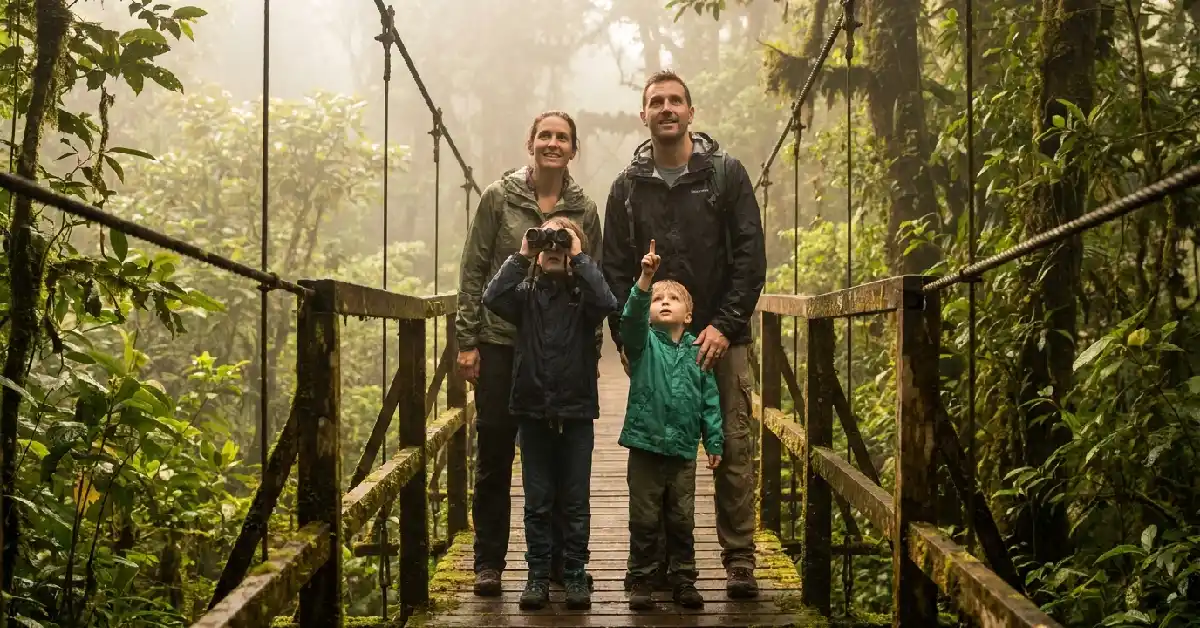
This costa rica travel guide for families begins with a confession.
I almost cancelled our first trip. My daughter was five. My son was eight. I had read eleven different articles, joined three Facebook groups for family travel, and still felt like I didn’t know anything real. Every guide said the same things in the same cheerful voice: “Costa Rica is perfect for families! So much wildlife! The beaches are pristine!” What none of them told me was that the road to Monteverde would make my son throw up twice, that the “gentle family hike” in the park brochure would involve crossing a river in sandals, or that the first sloth we’d spot wouldn’t be in a national park at all, it would be hanging off a telephone wire in a random town at 7am, while we were still looking for coffee.
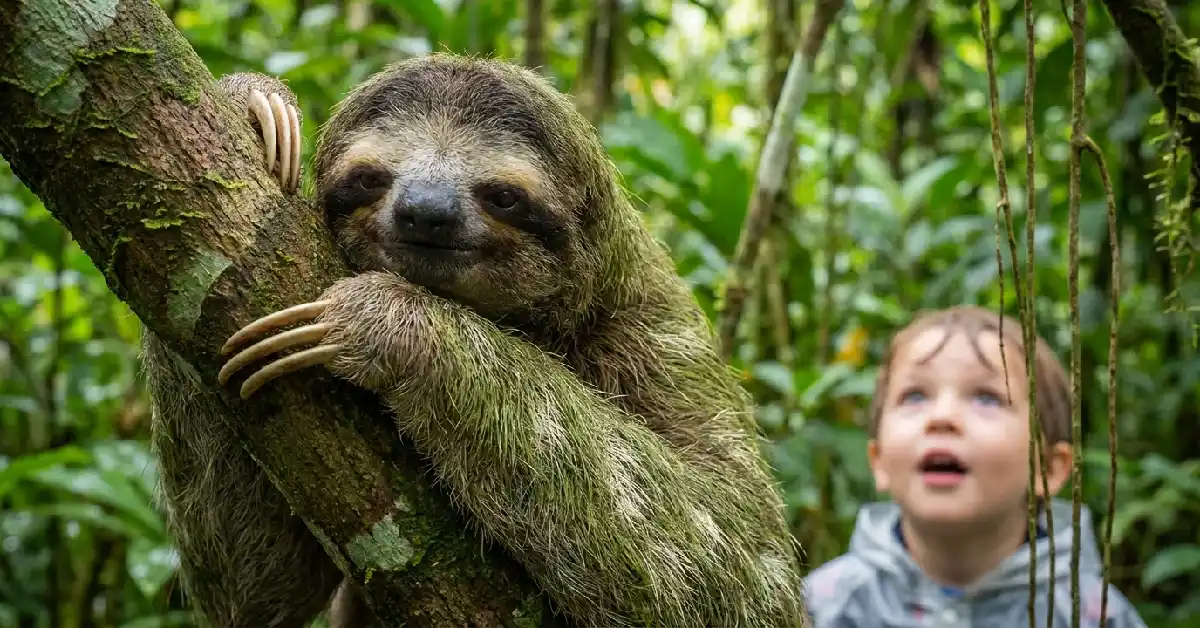
That sloth changed the whole trip. Not because it was majestic. Because my kids completely lost their minds over it, right there on a cracked sidewalk, in front of a tienda selling plantain chips. No tour- No guide – No entrance fee.
That’s the thing about Costa Rica with kids. The country keeps ambushing you with wonder when you’re not ready for it.
So here’s the version of this costa rica travel guide for families that I actually needed before I left.
Why Most Costa Rica Travel Guides for Families Are Telling You the Right Things in the Wrong Order
Every guide leads with beaches and wildlife. Those things are real and they’re spectacular. However, they’re not what makes or breaks a family trip here.
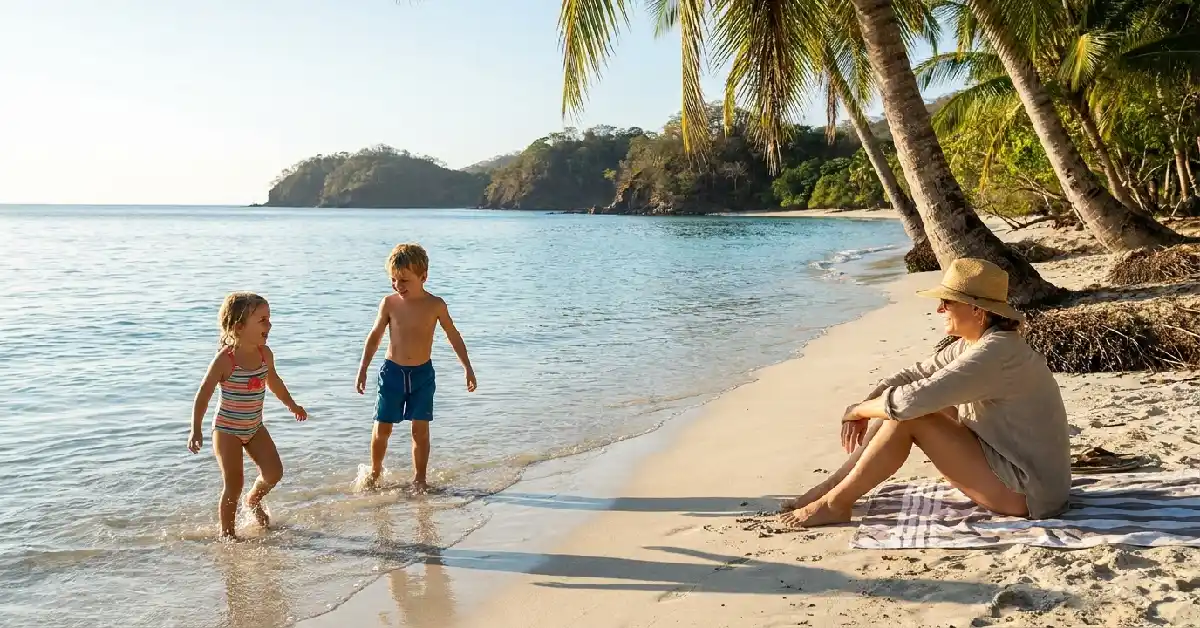
What makes or breaks it is this: Costa Rica is not one destination. It is five, stitched together by roads that look short on a map and feel eternal in a car with restless children. Guanacaste in the northwest is beach culture, dry, golden, windy in December, calm in January. Arenal is jungle drama, volcanoes, hot springs, zip lines, howler monkeys screaming at 5:30am like the world is ending. Monteverde is cloud forest mysticism, cool, misty, impossibly green, with bridges swaying over canopy gaps. Manuel Antonio is coastal rainforest, compact, wildlife-dense, beach-backed. The Caribbean coast is something else entirely: slower, rougher around the edges, more local, more raw.
Each one is worth visiting. None of them is the same trip.
The first thing this costa rica travel guide for families will do is help you figure out which Costa Rica belongs to your family, right now, with the ages your kids actually are, not some idealized travel version of them.
Is Costa Rica Really Good for Kids? (Yes. Here Is the Specific Reason Why.)
Most answers to this question are vague. “Family-friendly culture.” “Safe.” “Lots to do.” All true. But the specific reason Costa Rica works so well for families is something I didn’t understand until I was already there.
Costa Ricans raise children communally. Not in a figurative sense. In an actual, practical, every-day sense. The tour guide in Arenal who crouched down to show my eight-year-old how to find a spider monkey by listening for branch movement, he was a father. The woman at the soda restaurant in La Fortuna who brought my five-year-old a bowl of warm rice before she’d even sat down, she was a grandmother. The park ranger at Manuel Antonio who pulled out a laminated animal card specifically because he saw my kids squinting at something in the tree, he was the youngest person on staff that morning.
None of those things were part of a job description. They were just how people behave here toward children.
That said, this isn’t a fairy tale. According to the Costa Rica Tourism Board (ICT), family travel accounts for over 30% of international tourism to the country. That popularity means popular spots fill up fast, prices at peak season are real, and some “family-friendly” marketing covers experiences that work a lot better for adults than for an exhausted six-year-old at 2pm.
Costa Rica Safety for Families – The Honest Numbers and the Honest Caveats
Costa Rica abolished its military in 1948. It consistently ranks among the top three safest countries in Latin America on the Global Peace Index. Those are facts. Here are also facts:
- A friend’s camera bag was stolen from her unlocked rental car in Jacó. Twenty minutes. Busy street. $800 gone.
- Riptides on the Pacific coast, including at beaches that look completely calm, pull experienced adult swimmers. Every year.
- San José traffic and petty theft near the main bus terminal are real considerations.
None of this disqualifies Costa Rica. All of this is manageable with basic attention. Use registered tour operators (look for the ICT Certification of Sustainable Tourism badge). In cities, use Uber or official orange taxis. Never leave anything visible in a parked car. Before your kids enter the ocean anywhere on the Pacific, ask someone local about current conditions, not TripAdvisor, not a review from last March. Ask your hotel that morning.
My friend’s stolen bag ruined two vacation days. A locked car door would have prevented it completely. That’s not a Costa Rica failure. That’s a travel-anywhere lesson she had the unfortunate luck to learn in a beautiful country.
Best Time to Visit Costa Rica With Your Family (The Answer Is: It Depends on Your Specific Kids)
“Go in dry season.” Every guide says it. Technically correct. Practically incomplete.
Dry Season (December–April): Best for Families With Kids Under Seven
Book dry season. Don’t overthink it. Here’s why it matters specifically for young children: a toddler’s entire emotional landscape can collapse when the afternoon rain cancels the beach plan. With dry season, that doesn’t happen. Mornings are clear in Guanacaste. Afternoons stay clear. You can build a predictable rhythm, beach, nap, dinner, repeat, and everyone stays functional.
We visited in January on our first trip. Ten days, zero rain, Guanacaste coast. My five-year-old napped under a thatched palapa while my eight-year-old snorkeled fifteen feet away in water so calm it looked like a pool. I read half a book. Uninterrupted. In Costa Rica. With two kids. That required dry season conditions.
The trade-off: prices are 20–40% higher. Manuel Antonio sells out. Tamarindo gets crowded. Playa Flamingo in Christmas week looks like a resort hotel lobby. Book early, pay the premium, and accept that you’re not the only family who figured this out.
Green Season (May–November): Best for Families With Older Kids and Teens
Here is the thing guides never say out loud: the green season is secretly excellent for families with kids ten and older, and significantly better for teenagers specifically.
Rain comes in intense afternoon bursts, forty-five minutes of proper tropical drama, then it stops and everything smells green and electric and alive. Waterfalls triple in volume. Wildlife sightings increase because animals move more. Prices drop 20–30%. And teenagers, who have typically pre-decided that a “family nature trip” sounds deeply uncool, respond to a country that feels untamed and a little unpredictable in a way they simply don’t respond to a polished resort itinerary.
Our second trip was September. My then-thirteen-year-old, who had negotiated extensively about whether this trip was “worth missing a week with friends,” came home and told three separate people it was the best trip of his life. The rain helped. The drama of it. The way mornings felt urgent and real.
Structure your days like this: hard activities by 11am, lunch, let the rain arrive, pool or hammock or local market in the afternoon, evening activity after it clears. It works every time.
School Holiday Reality Check:
- Christmas/New Year: Most expensive, most crowded. Book 6+ months out or you’re paying panic prices.
- Spring break (March–April): Near-perfect conditions. Book 4–5 months out.
- Summer (June–August): Green season, lower cost, great for active families who can handle a flexible schedule.
Must Read: The AI Travel Planner Free 2026 That Changed How I Plan Every Trip
The Costa Rica Family Vacation Budget That Nobody Actually Publishes
Real numbers. Here they are.
Budget Trip: $150–$200 Per Day for a Family of Four
- Accommodation: $60–$90/night, guesthouse or basic hotel with kitchen access
- Food: $40–$60/day eating at local sodas, a casado (rice, black beans, protein, salad) costs $6–$9 per person, and the portions are genuinely enormous
- Activities: $50–$80/day, national park entry is $18–$25 per adult, often half for kids under 12
- Transport: $30–$50/day via domestic shuttle or a shared rental car
Ten days for a family of four: approximately $1,800–$2,200, not counting flights. This is a real, excellent trip. The secret weapon at this budget level is eating where locals eat. Not where the sign says “Authentic Costa Rican Cuisine” in English. At the actual soda down the road, where the rice was made that morning and the family who owns it will try to talk to your kids in Spanish and be delighted when they try to answer.
Mid-Range: $300–$500 Per Day for a Family of Four
Comfortable hotel or Airbnb with pool, one or two guided tours daily, rental car for flexibility, a mix of local and nicer restaurant meals. Total for ten days: $3,500–$5,500 excluding flights. This is the sweet spot for most visiting families.
Three Things Worth Spending More On, No Matter Your Budget
A naturalist guide at Manuel Antonio. We skipped the guide on our first morning to save sixty dollars. We walked the main trail for two hours, We saw coatis stealing someone’s sandwich, which was entertaining, and approximately zero sloths. The next morning we hired a guide. She found three sloths in forty-five minutes, a Jesus Christ lizard, a boa constrictor draped across a branch seven feet over our heads, and a poison dart frog so small it could have sat on my thumbnail. Sixty dollars. Absolutely worth it every single time.
Private transfer from Liberia to La Fortuna ($180–$220 total). Shared shuttles take eight hours with no reliable bathroom stops. The private car takes four and a half hours with two stops of your choosing. When you have kids in the back seat and three hours of mountain road ahead of you, this is not a luxury calculation. It’s a survival calculation.
One extra night, anywhere. The most expensive mistake families make in Costa Rica is over-scheduling. Build in one buffer day per region. The best moment of our entire first trip happened on a day we had nothing planned, we found a local waterfall by asking a woman at a fruit stand, drove twenty minutes down a dirt road, and had it completely to ourselves for an hour.
Best Places in Costa Rica for Families – Matched to Your Kids’ Actual Ages
For Toddlers and Under-5s: Guanacaste
Tamarindo, Playa Flamingo, Playa Potrero, Playa Conchal. These beaches work for toddlers because the water is calm, genuinely calm, not “calm for the Pacific” calm, and the infrastructure is strong. Rental car agencies in Liberia keep car seats. Supermarkets stock familiar diapers and formula. Hotel pools are plentiful. The airport (LIR) is forty-five minutes away, which matters enormously at the end of a long travel day with a tired two-year-old.
One thing nobody mentions: Playa Conchal is made of crushed seashells, not sand. It crunches differently underfoot. Toddlers find this fascinating and will spend twenty minutes examining the ground before they even look at the ocean. Budget for that.
Avoid the Caribbean coast with very young children. The roads into Puerto Viejo and Cahuita are rough and slow. Infrastructure is limited. The Atlantic waves are unpredictable. It’s a wonderful destination, for a different season of family travel.
For Kids Ages 6–12: Arenal and Manuel Antonio
Arenal delivers what it promises in a way few places on earth actually do. The volcano is real. The jungle is loud, genuinely, disruptively loud. Nobody prepared me for what 5:30am sounds like when a troop of howler monkeys decides to announce the dawn from a tree forty meters from your room. It sounds like something enormous is in pain. My son, eight years old at the time, sat up in bed completely rigid for about three seconds, then started laughing so hard he woke his sister.
He still talks about it. More than the zip line. More than the hot springs. The morning the monkeys woke him up.
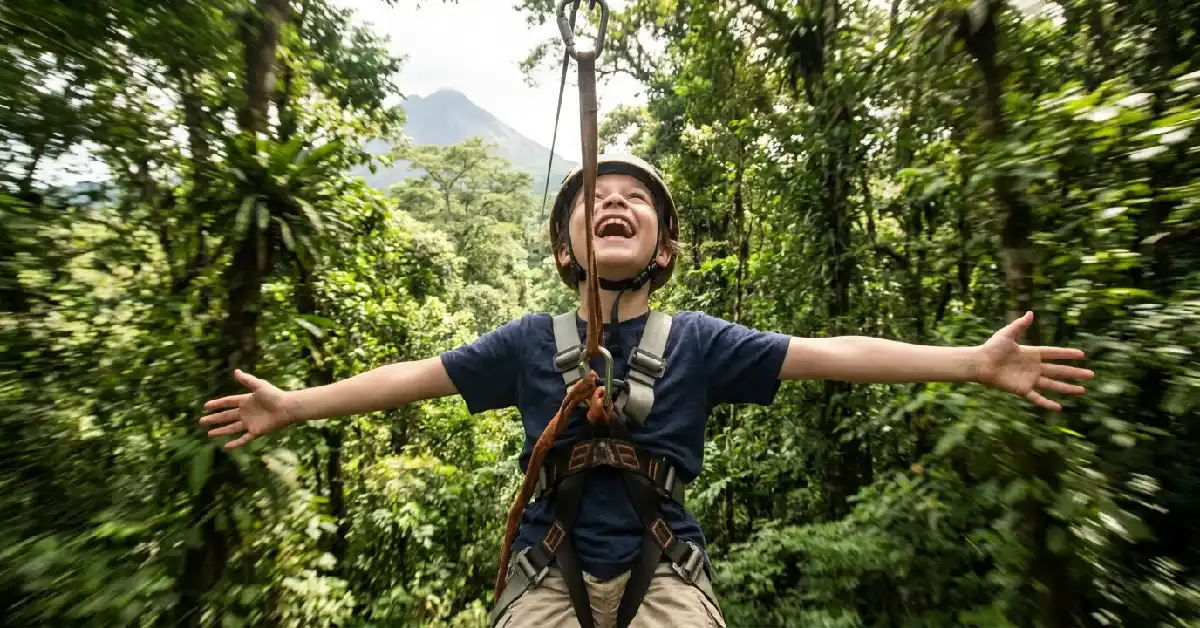
Ziplining starts at age 8 at most reputable operators in Arenal. Hanging bridges are walkable at any age and genuinely stunning, you’re in the canopy, not looking at it. Hot springs in the evening are a perfect family reset after a full activity day. White-water rafting on the Balsa River has Class II options for kids from age six.
Manuel Antonio is the country’s most family-accessible national park. Small enough to do in a focused half-day, dense enough to feel like something is happening around every corner. Arrive before 8am. Bring your own water and snacks. Hire a guide. Leave by noon before the heat peaks and the crowds fill in.
For Teenagers: Monteverde and Santa Teresa
A thirteen-year-old who has pre-decided that family vacations are a form of social punishment will, within forty-eight hours of arriving in Monteverde, completely change their mind. The zip lines here are among the longest in the world. The night walks involve headlamps and tarantulas and tree frogs that look like they were designed by someone who loves green and red together. The whole place feels like a setting for an adventure film, except it’s real and you’re in it.
Santa Teresa is surf culture, undiluted. Beginner lessons run $45–$65 for two hours with instructors who have worked with young surfers for years and know that making the first session fun matters more than teaching perfect form on day one. By day three, your teenager will have sand in their hair and a new opinion about whether they wanted to come on this trip.
Things to Do in Costa Rica With Kids – The Ones That Actually Deliver
Wildlife Experiences That Reliably Work for Families With Kids
Sea turtle nesting at Tortuguero (October–February). A 300-pound leatherback turtle pulls herself up a dark beach, digs a nest with her flippers, and lays over a hundred eggs by moonlight, and none of it makes a sound except the ocean. My daughter was nine. She held my hand the entire time and didn’t say a single word until we were back at the boat. Then she said, “She worked so hard.” That’s it. That’s the whole experience, perfectly described by a nine-year-old. Book only through certified guides, unregulated beach access is illegal and genuinely harmful to nesting turtles.
Sloth spotting at Manuel Antonio. Go between 7am and 9am. Sloths are marginally more active then, which still means they move approximately three inches per hour, but their position in the tree is different enough to spot. A guide makes the difference between “I think I see something brownish?” and “That sloth just turned its head and looked directly at your child.” The latter is available. Bring the guide.
Night walk in Monteverde or Curi-Cancha Reserve. Red-eyed tree frogs. Stick insects that look exactly like sticks until they don’t. Tarantulas sitting completely still on a branch, doing nothing threatening, looking absolutely terrifying and magnificent. Children who are normally reluctant to walk anywhere become fascinated and laser-focused. The headlamp helps. The guide, again, is everything.
Adventure Activities – Age-by-Age Quick Reference
| Activity | Min. Age | Cost Per Person | Best Region |
|---|---|---|---|
| Beginner surf lesson | 6+ | $45–$65 | Santa Teresa, Tamarindo |
| Zipline (standard) | 8+ | $55–$90 | Arenal, Monteverde |
| Hanging bridges walk | All ages | $25–$35 | Arenal, Monteverde |
| White-water rafting Class II | 6+ | $65–$85 | Arenal (Balsa River) |
| White-water rafting Class III/IV | 12+ | $75–$95 | Turrialba |
| Night walk | All ages | $25–$40 | Monteverde, Tortuguero |
| Sea turtle tour | 5+ | $40–$60 | Tortuguero |
| ATV tour | 16+ (driver) | $75–$120 | Guanacaste |
Educational Eco-Tourism – The Angle This Costa Rica Travel Guide for Families Won’t Let You Skip
Most families treat Costa Rica’s educational angle as a bonus. It shouldn’t be. It should be a central reason you’re going.
Bribri Indigenous cultural tours (near Puerto Viejo): A family-led experience built around traditional cacao farming, forest medicine plants, and the specific relationship between the Bribri people and the land they’ve stewarded for generations. For school-age children, it is more meaningful than any classroom unit on ecology or indigenous culture. It is also deeply, quietly moving, the kind of experience that doesn’t land fully until your child mentions it three months later, unprompted, at dinner.
Kids Saving the Rainforest (Quepos/Manuel Antonio): A wildlife rescue organization that was, remarkably, co-founded by children. Tours are run by young staff and volunteers, and they show kids the unglamorous operational reality of conservation, cleaning enclosures, preparing food for orphaned animals, monitoring recovery progress. My daughter came here at age nine. She went quiet for an hour afterward. Then said she wanted to work there when she grew up. A zip line is exciting. This is formative.
Half-day Spanish immersion programs for kids: Available in Tamarindo and La Fortuna. Even learning eight phrases, hello, thank you, how much does this cost, what is that animal called, gives children a completely different relationship to the place they’re visiting. It also, invariably, becomes a family competition by day three. My son ordered our entire lunch in Spanish on day four. In broken, heroically confident Spanish. The waiter played along beautifully.
Where to Stay – Costa Rica Family Resorts vs. Vacation Rentals (The Real Comparison)
For families with kids under six: All-inclusive resorts win. Specifically: you’re not making fifteen daily micro-decisions about meals, you have a pool immediately available when the heat becomes a problem, and there’s usually a kids’ club for the two hours in the afternoon when everyone needs to be in different rooms. Top options in Guanacaste include the Westin Reserva Conchal (beautiful, polished, reliable), the Andaz Peninsula Papagayo (modern, design-forward, excellent service), and the RIU Palace Costa Rica for a more budget-conscious all-inclusive option.
For families of five or more, or stays of seven or more nights: Vacation rentals. Without question. A kitchen means you can buy local fruit, stock the snacks your kids will actually eat, make coffee at 6am without waking anyone, and do a load of laundry at the four-day mark when everything smells like jungle and sunscreen. Look for rentals near Playa Flamingo, Nosara, or Dominical, each offers a different version of the “comfortable house in nature” experience.
The mid-trip laundry option is underrated in every packing guide ever written. When you’re traveling for ten days with kids, it is genuinely life-changing.
Costa Rica Packing List for Kids – By Age, Not by Generic Travel List
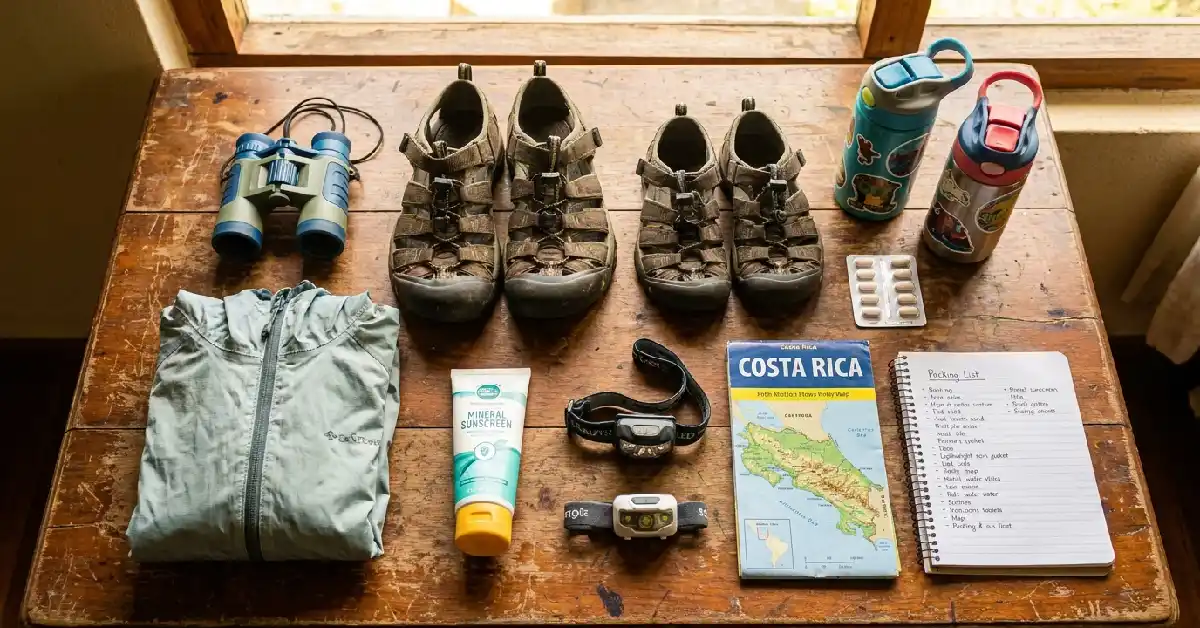
Babies and Toddlers: What You Cannot Buy Easily There
Bring more diapers than you think you need. Local brands exist but sizing differs from US and European standards, especially in smaller sizes. Bring your own structured carrier, trails in national parks don’t always accommodate strollers, and rental carriers at tour operators range from fine to genuinely questionable. Bring electrolyte sachets (Pedialyte powder specifically): the combination of heat and new altitude can dehydrate toddlers faster than you expect. Long-sleeve rashguard swimwear, wide-brim swim hat. Infant life jacket if you’re doing any boat tours, don’t count on rental quality for this one.
School-Age Kids (6–12): The Items That Actually Changed Our Experience
Waterproof sandals (Keens or Tevas, not knockoffs, they need to survive river crossings, muddy trails, and beach time simultaneously). Lightweight rain jacket, not a poncho, ponchos catch on branches and vegetation in a way that becomes extremely frustrating very fast. Kids’ binoculars: this was the single item that most changed how my kids experienced wildlife. Not a phone camera. Actual binoculars, sized for children’s faces. We spotted things with them we would have walked past entirely. Small headlamp: non-negotiable for night walks and for eco-lodges when the power dips at 9pm. Motion sickness tablets: the road to Arenal involves roughly nine thousand curves through mountain terrain. My son had never needed these before in his life. He needed them on that road. Pack them regardless of history.
Teenagers: Gear That Earns Cooperation
A GoPro or waterproof action camera. They will want to document everything, and they should, it gives them a narrative role in the trip rather than a passenger role. Their own day pack: this creates ownership over the experience in a way you cannot manufacture otherwise. A teenager who is responsible for their own water, sunscreen, and headlamp is a different traveler than one who is handed things all day. Quick-dry clothing they chose themselves, let them pick, within reason. Duolingo Spanish downloaded offline, ideally started two weeks before departure. Frame it as competition. Watch what happens.
Health, Safety, and What to Do When It Goes Wrong
Medical Prep Before You Leave
The CDC recommends routine vaccinations are up to date, plus Hepatitis A for all travelers. Malaria risk is low in most tourist areas; however, if you’re visiting Tortuguero or remote Caribbean regions, talk to your pediatrician at least four weeks before departure about appropriate prophylaxis.
Carry in your family kit: antihistamine cream (bug bites near water and at dusk are constant), oral rehydration salts, children’s ibuprofen and acetaminophen, a digital thermometer, and antibacterial wipes. You can buy most of this in Costa Rica, but buying it stressed at a farmacia while a feverish child waits in the car is a different experience than having it ready.
If Your Child Gets Sick There
Private clinics (Clínicas) are available in every major tourist area, Tamarindo, La Fortuna, Quepos, San José. English-speaking staff are common. A standard visit costs $40–$80 out of pocket, which is often less than a US urgent care copay. The healthcare system in Costa Rica is meaningfully better than most first-time visitors expect.
Travel insurance is not optional when traveling with children. This is not boilerplate language. Get it. World Nomads and Allianz both offer solid family plans with emergency medical evacuation and adventure activity coverage included. The one trip you skip insurance is statistically the one where you need it. That’s not superstition. That’s just how these things work.
What Nobody Tells You – Real Talk About Costa Rica With Kids
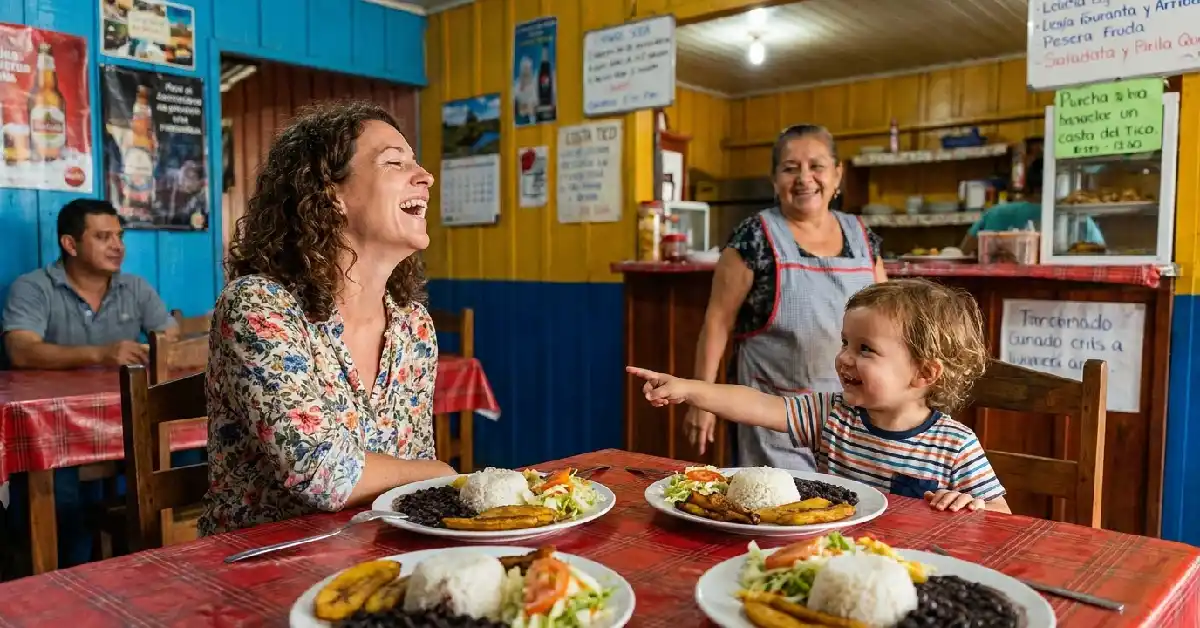
The drives are significantly longer than maps suggest. Google Maps will say ninety minutes. It will take two and a half hours. Add a bathroom stop. Add the time your kids spend watching out the window at something they insist was a monkey. Budget three hours for anything over an hour. Download movies offline before you leave. No shame in that.
Humidity is not a vibe. It’s a physical condition. The moment you step off the plane in Liberia or San José, the air changes. Kids who dislike feeling hot and damp will announce this regularly for the first forty-eight hours. Set expectations before you go. Tell them: it’s going to feel tropical, and that’s the point.
Not every beautiful beach is a safe swimming beach. This is the one that matters most. Playa Hermosa near Jacó is one of the most visually stunning beaches in the country. It also has riptides that have killed experienced swimmers. Always, always ask your hotel or a local guide about specific conditions before children enter the ocean on the Pacific coast, not reviews, not Google, ask someone that morning who actually knows what the water is doing right now.
The monkey will steal the food. At Manuel Antonio, a white-faced capuchin monkey took a granola bar from my son’s hand in under a second. Clean extraction. My son’s face, genuine shock collapsing immediately into total delight, is the photo I look at most from the entire trip. You cannot plan for this. The best moments never announce themselves.
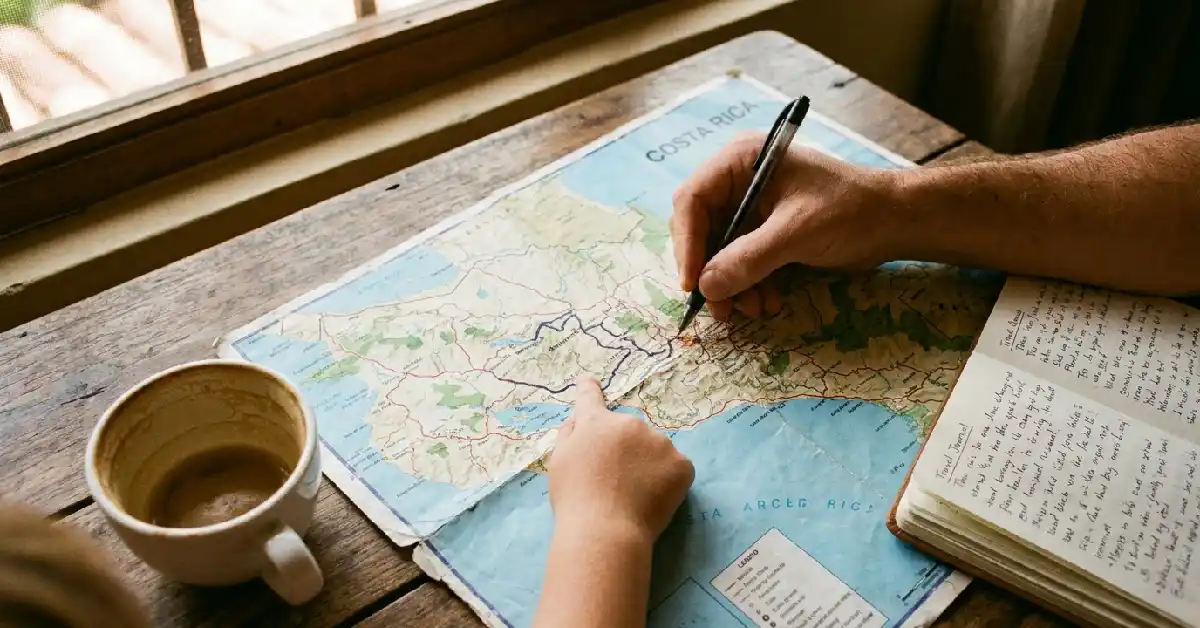
A 10-Day Costa Rica Itinerary for Families That Has Breathing Room Built In
| Day | Plan | Details |
|---|---|---|
| Day 1 | Arrival & Relax | Arrive at Liberia (LIR) → Transfer to Guanacaste accommodation → Beach afternoon → Easy dinner → Early sleep |
| Day 2 | Rest & Decompression | Full beach and pool day → No activities → No fixed agenda → Relax and adjust |
| Day 3 | Adventure Activity | Guided wildlife tour or half-day zip line in Guanacaste (pre-book recommended) |
| Day 4 | Waterfall Visit | Visit Llanos de Cortez Waterfall (45 mins from Liberia) → Free entry → Less crowded → Swim & relax |
| Day 5 | Travel to Arenal | Drive to La Fortuna/Arenal (~4 hrs with stop) → Hotel check-in → Arenal Natura wildlife walk at sunset |
| Day 6 | Nature & Hot Springs | Morning: Mistico Arenal Hanging Bridges (7 AM) → Evening: Tabacón Hot Springs |
| Day 7 | Adventure / Flexible Day | Option 1: White-water rafting (Class II or III) → Option 2: Rest day + ATV half-day tour |
| Day 8 | Long Drive Day | Drive toward Manuel Antonio (~6 hrs total) → Stop for lunch in Quepos → Break journey for comfort |
| Day 9 | National Park & Beach | Manuel Antonio National Park (7 AM entry with guide) → Exit by noon → Beach afternoon |
| Day 10 | Departure | Beach morning → Pack → Depart via San José (SJO) or drive back to Liberia (LIR) |
The airport decision: Flying in and out of Liberia (LIR) instead of San José adds one full day of actual vacation time by eliminating the long first-day and last-day San José transfers. For a Guanacaste/Arenal itinerary, which is the most family-practical route, it’s the obvious choice and most families don’t know to make it.
Final Thoughts on This Costa Rica Travel Guide for Families
Here is what I know after two trips with kids at different ages:
The families who get the most from Costa Rica are not the ones who planned the most. They’re the ones who planned enough, then left space for the country to surprise them.
The sloth on the telephone wire. The howler monkeys at 5:30am. The granola bar theft. The turtle working so hard on a dark beach. The road to nowhere that turned into the best afternoon of the trip. None of those were on an itinerary. All of them are what my kids remember.
Use this costa rica travel guide for families to make the structure solid. Then hold the structure loosely. Let things happen that weren’t in the plan. Eat at the soda that doesn’t have a website. Take the road your rental car host mentions offhand. Say yes to the slower pace that the country is constantly, patiently offering you.
Costa Rica has been teaching families what pura vida actually means for decades. It just takes a few days of letting go of the schedule to hear it.
FAQ
Is Costa Rica a good destination for families with young children?
Yes. Costa Rica is the safest country in Central America, with a deeply family-oriented culture where children are welcomed rather than merely accommodated. Infrastructure supports families with car seat availability at rental agencies, stroller-accessible trails in major national parks, and family-rate pricing at most attractions. Families with children under five do best in the Guanacaste region during dry season (December–April), which offers calm swimming beaches and predictable weather.
What is the best time to visit Costa Rica with kids?
It depends on your children’s ages. Families with young children (under seven) should prioritize dry season (December–April) for predictable weather and calmer logistics. Families with older kids and teenagers can benefit significantly from green season (May–November): lower prices, more dramatic wildlife activity, and an atmosphere that resonates strongly with adventure-seeking kids. Book Christmas and spring break trips 5–6 months ahead.
How much does a family vacation to Costa Rica cost?
Budget families of four can plan 10 days for $1,800–$2,200 excluding flights, eating at local sodas and using shuttles. Mid-range families typically spend $3,500–$5,500 for the same duration with guided tours and a rental car. Round-trip flights average $450–$850 per person from the US. The single best budget decision is eating at local sodas rather than tourist restaurants, better food, bigger portions, fraction of the price.
What are the best places in Costa Rica for families?
Guanacaste (Tamarindo, Flamingo, Conchal) is best for toddlers and under-fives, calm water, strong infrastructure, easy airport access. Arenal and Manuel Antonio are ideal for school-age kids (6–12) with ziplining, hanging bridges, hot springs, and accessible wildlife. Monteverde and Santa Teresa are the right choices for teenagers who want surfing, zip lines, and genuine adventure rather than a managed resort experience.
Do I need travel insurance for Costa Rica with kids?
Yes, without exception. Medical care in Costa Rica is better than most visitors expect and relatively affordable, but emergency medical evacuation, unexpected illness requiring extended care, or trip cancellation can be very costly without coverage. World Nomads and Allianz both offer strong family plans that include adventure activity coverage. Buy it before you need it, which in traveling with children is more likely than you think.